Softwood gets overlooked for wall art more often than it should, mostly because "soft" sounds like a downside rather than a genuine tradeoff. In practice, softwoods are generally more affordable, easier to cut and carve, and in some cases, like cedar and redwood, naturally resistant to rot and insects in a way many hardwoods aren't. The right softwood depends on your budget, your tools, and whether the piece needs to handle moisture or outdoor exposure. Here's a practical breakdown of the most common options.
Top Softwoods for Wall Art
Each of these species brings its own balance of cost, workability, and natural resistance, and knowing the basics makes it much easier to pick the right one for a specific project.
|
Species
|
Color
|
Hardness
|
Grain
|
Cost
|
Best For
|
|
Pine
|
Pale yellow to cream, often knotty
|
Soft
|
Straight, visible knots
|
Low
|
Budget projects, rustic and distressed looks, beginners
|
|
Cedar
|
Reddish-brown to pale cream
|
Soft
|
Straight, aromatic
|
Low to moderate
|
Humid rooms, insect-prone areas, outdoor-adjacent spaces
|
|
Douglas Fir
|
Reddish-brown to yellow
|
Moderate (hardest common softwood)
|
Straight, pronounced
|
Moderate
|
Larger pieces, more durable softwood projects
|
|
Spruce
|
Pale white to yellow
|
Soft to moderate
|
Fine, straight, subtle
|
Low
|
Lightweight pieces, pale minimalist looks
|
|
Redwood
|
Reddish-brown
|
Soft
|
Straight, fine
|
Moderate to higher
|
Outdoor or semi-exposed wall art, natural rot resistance
|
Pine
Pine is the most widely used softwood for DIY wall art, prized for its low cost and easy workability. Its visible knots and pale, straightforward grain give it a casual, rustic character that suits distressed or farmhouse-style projects especially well, though it's prone to blotchy stain absorption without a pre-stain conditioner.
Cedar
Cedar stands out for its natural resistance to rot, decay, and insects, a quality that comes from the aromatic oils within the wood itself rather than any applied treatment. This makes it a strong choice for wall art headed into a humid bathroom, a covered porch, or anywhere with more moisture exposure than a typical living space, without needing the heavy sealing other softwoods would require in the same spot.
Deploying natural aromatic oils to resist moisture and insects in damp spaces
Douglas Fir
Douglas fir is noticeably harder and stronger than most other softwoods, closer in some respects to a lighter hardwood than a typical soft, easily dented species. Its straight, pronounced grain and reddish-to-yellow tone give it a bolder visual presence, and its added strength makes it a good choice for a larger panel or piece that needs to span real size without as much risk of warping or sagging.
Spruce
Spruce is pale, lightweight, and fine-grained, often used where a light color and minimal visual weight matter more than raw durability. It's one of the softer options on this list, better suited to a decorative piece that won't see much handling than to anything expected to take regular bumps or impact.
Selecting lightweight pale timber for minimalist and decorative interior displays
Redwood
Redwood shares cedar's natural rot and insect resistance, thanks to its own protective oils and tannins, and brings a distinctive reddish-brown color that darkens attractively with age. It's a solid choice for a piece that might see occasional moisture or sit somewhere semi-exposed, though it's worth sourcing responsibly, since old-growth redwood harvesting carries real sustainability concerns that plantation-grown or reclaimed redwood avoids.
>>> Read more: How to Choose a Wood Finish for Wall Art: A Complete Decision Guide
How to Choose the Best Softwood for Your Project
With a few genuinely different softwoods to pick from, a handful of practical priorities make the decision easier.
If Budget Is Your Main Priority
Pine and spruce are typically the most affordable options on this list, both widely grown and commercially available in a range of sizes. Pine in particular is easy to find at any hardware store in a variety of board widths and thicknesses, which makes it a practical default for a larger piece or a first attempt where keeping costs down matters more than premium grain character. Spruce runs similarly affordable but is less commonly stocked for decorative work specifically, so availability can vary more by region.
If the Piece Is Headed for a Humid or Outdoor-Adjacent Space
Cedar and redwood both bring genuine natural resistance to moisture, rot, and insects, a real practical advantage over pine or spruce in anything beyond a stable, dry interior room. That built-in resistance comes from the wood's own oils and tannins rather than a topical treatment, which means it holds up even if a sealant coat wears thin before you get around to refreshing it. For a covered porch, a sunroom, or a humid bathroom specifically, either of these is a more forgiving starting material than a standard softwood that depends entirely on its finish for protection.
Relying on cedar and redwood's built-in decay resistance for covered porches and bathrooms
>>> Read more: Is Wood Wall Art Safe for Humid Climates?
If You Need a Larger or Structurally Demanding Piece
Douglas fir's added strength and stiffness compared to other softwoods make it the better choice for a large panel or a piece that needs to span real width without sagging or developing a warp over time. Pine and spruce can still work at larger sizes, but they typically need more structural backing or thicker stock to achieve the same rigidity Douglas fir offers more naturally. This matters most for anything approaching furniture-scale dimensions rather than a modest accent piece.
If You're New to Woodworking
Pine remains the most forgiving softwood for a first project, since it cuts, carves, and sands easily with basic tools, and mistakes are generally easier to correct on a soft, workable material than on a denser one. Its tendency to blotch under stain is a known, manageable issue, solved with a pre-stain conditioner, rather than a dealbreaker for a beginner-friendly build.
Mastering basic cuts and carving techniques on forgiving beginner-friendly pine boards
Frequently Asked Questions About the Best Softwood for Wall Art
Is softwood durable enough for wall art?
Yes, for most wall art applications. Softwoods dent and scratch more easily than hardwoods, but wall-mounted pieces generally see far less handling and impact than furniture or flooring, which makes that softness a much smaller practical concern than it would be elsewhere.
Which softwood is best for a humid bathroom?
Cedar and redwood are the strongest choices, thanks to their natural rot and insect resistance, which gives them an advantage over pine or spruce in consistently damp conditions, even before any sealant is applied.
Why does pine need a pre-stain conditioner?
Pine's density varies significantly between its softer and harder grain bands, which causes uneven, blotchy stain absorption without a conditioner to even things out first.
Is Douglas fir considered a hardwood or softwood?
Despite being noticeably harder than most other softwoods, Douglas fir is still botanically classified as a softwood, since that classification is based on tree type (conifer vs. broadleaf) rather than actual wood hardness.
Is redwood sustainable to use for wall art?
It depends on the source. Plantation-grown or reclaimed redwood is a sustainable choice, while old-growth redwood harvesting raises real environmental concerns, so it's worth asking about sourcing before buying redwood specifically.
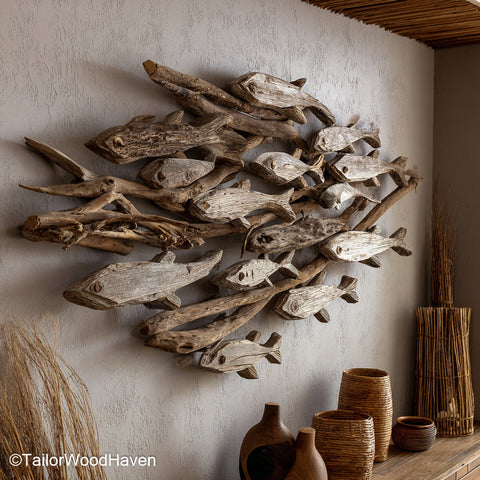
The best softwood for wall art depends heavily on where the piece is headed and what you're optimizing for. Pine and spruce keep costs down and suit beginner-friendly or rustic projects, cedar and redwood bring real moisture resistance to a humid or semi-exposed space, and Douglas fir offers the strength to handle a larger, more demanding design. Our driftwood wall art collection draws on naturally weathered softwood character for a similar rustic feel without the DIY effort, and our carved wood wall art is worth a look if you'd rather go with a harder, more detail-friendly material instead.
If you're not sure which wood type fits your space or project, the team at Tailor Wood Haven can help you think it through before you commit.
|
TAILOR WOOD HAVEN
Address 1: 412 Palmetto Dr, Columbia, SC 29201
Address 2: 1201 Hillside Avenue, Victoria, British Columbia V8T 2B1, Canada
Address 3: Phu Thai Town, Hai Phong 03306, Vietnam
Call us: +1 (647)-608-1571
Email: hello@tailorwoodhaven.com
|
 Skip to content


 Farmhouse Floating Shelves – Perfect handcrafted furniture
 Farmhouse Narrow Console Table with Storage for Entryway or Living Room
 Custom Rustic Console – Natural Wood, Made to Order