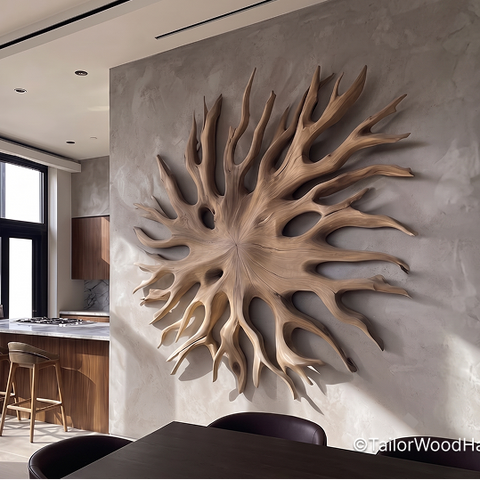
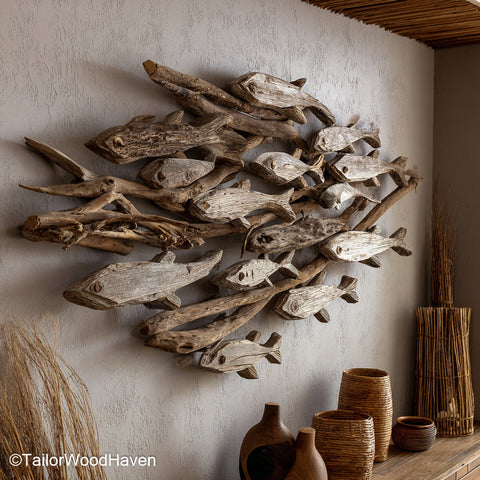
Wood and humidity have a genuinely complicated relationship, and whether a piece of wood wall art is safe for a humid climate depends on more than just the fact that it's wood. The honest answer is: it depends on the wood itself, how it was dried and finished, and how much the humidity actually fluctuates rather than just sitting consistently high. A piece that would struggle in a climate with big seasonal humidity swings can do perfectly fine in a climate that's consistently humid but stable, since it's the swings, not the humidity level alone, that cause most wood damage.
Why Humidity Affects Wood Wall Art
Wood is hygroscopic, meaning it naturally absorbs and releases moisture from the surrounding air, expanding slightly as it takes on moisture and shrinking as it releases it. In a climate that holds a steady, if elevated, humidity level year-round, wood settles into an equilibrium with that moisture level and tends to stay fairly stable once it's acclimated. The real risk comes from fluctuation, a wet season followed by a dry one, or air conditioning cycling a room between humid and dry conditions throughout the day, since that back-and-forth movement is what causes warping, cracking, and joint failure over time.
Understanding how hygroscopic expansion and contraction cause warping during seasonal moisture swings
What Makes Wood Wall Art More Humidity-Resistant
A few specific factors determine whether a given piece can handle a humid environment well.
Wood species plays a real role, since denser woods like teak, walnut, and certain tropical hardwoods naturally resist moisture absorption better than softer, more porous species. Teak in particular is prized in humid and marine environments specifically because of its natural oils and tight grain structure, which slow moisture penetration significantly compared to most other woods.
Proper drying before construction matters just as much as species choice. Wood that was kiln-dried or properly seasoned to a stable moisture content before being built into a finished piece has already gone through much of its initial shrinkage, making it considerably more stable in a humid environment than wood that was rushed through drying or used while still relatively green.
Sealing on every surface, not just the visible front, is one of the biggest factors within your control after a piece is already made. An unsealed back absorbs ambient moisture at a different rate than a sealed front, and that mismatch creates internal stress that leads to warping even in wood that would otherwise handle humidity reasonably well. A fully sealed piece, front, back, and edges, holds up dramatically better in humid conditions than one sealed only where it's visible.
Naturally weathered material has an advantage too, since wood that's already been exposed to years of moisture cycling before becoming art has, in a sense, already proven its stability. This is part of why pieces from a driftwood wall art collection, assuming they're properly finished afterward, tend to do reasonably well in humid settings. This driftwood lobster piece, for example, is specifically sealed for weather resistance and designed with exactly this kind of moisture exposure in mind.
Identifying the dense species and sealing techniques that prevent structural water damage
What to Avoid in a Humid Climate
Raw, unsealed wood is the biggest risk in any consistently humid environment, since it absorbs moisture unevenly and offers no protective barrier at all. Thin veneers over particleboard or MDF are also a poor fit for humid conditions, since the core material swells and deteriorates quickly once moisture gets past the thin outer layer, a failure mode solid wood doesn't share. Pieces finished only on the front, with the back or edges left raw, carry hidden risk even if they look fully finished at a glance, since the unsealed surfaces are usually invisible until a problem has already developed.
How to Make Any Piece More Humid-Climate Ready
If you already have a piece, or you're considering one that isn't specifically marketed as humidity-resistant, a few steps improve its odds. Keeping indoor humidity as stable as possible, ideally in the 30 to 50 percent range using a dehumidifier or air conditioning if needed, reduces the swings that actually cause damage. Checking that a piece is sealed on every surface, and adding a coat yourself to any exposed back or edge if it isn't, closes one of the most common gaps. Placing wood pieces away from direct sources of humidity, like a bathroom shower or an un-vented kitchen, and away from exterior walls that see more temperature and moisture swings than interior ones, also helps considerably.
Stabilizing indoor moisture levels and applying protective back-coats to existing wooden decor
>>> Read more: How to Clean Driftwood Wall Art: Safe Maintenance & Care Guide
Frequently Asked Questions About Wood Wall Art and Humidity
A few questions come up often once people start thinking seriously about humidity and wood wall art together.
Is any wood completely safe in a humid climate?
No wood is entirely immune to humidity's effects, but dense, naturally moisture-resistant species like teak, combined with proper drying and full sealing, come closest to handling consistently humid conditions well. Stability matters more than the humidity level itself, so a steady, if elevated, humid climate is often easier on wood than one with large seasonal swings.
Does carved or dimensional wood wall art handle humidity differently than flat pieces?
Carved and layered pieces can be more vulnerable in some ways, since recessed areas and joints give moisture more surface area and more places to collect, but a well-made, fully sealed carved piece, like those in a carved wood wall art collection, can still hold up well with proper care and a reasonably stable environment.
Can I use a dehumidifier to protect wood wall art in a humid home?
Yes, and it's one of the most effective steps available, since reducing the swings between humid and dry conditions does more for wood stability than almost any other single change. A consistent 30 to 50 percent indoor humidity range is a reasonable target.
Is driftwood wall art a good choice for a humid climate?
Often, yes, assuming it's properly sealed, since the wood has typically already been through extensive natural weathering and moisture cycling before being crafted into art, which gives it a head start on stability compared to freshly milled lumber.
Should I avoid hanging wood wall art in a bathroom if I live somewhere humid?
It's worth extra caution there specifically, since bathrooms see rapid humidity spikes from showers on top of an already humid climate. A fully sealed piece with good ventilation in the room reduces the risk considerably, but a consistently steamy bathroom with poor airflow remains one of the more challenging environments for any wood piece, humid climate or not.
>>> Read more: Coastal Driftwood Wall Art: Handcrafted Ocean-Inspired Decor for Modern Homes
Properly chosen and finished wood wall art can genuinely hold its own in a humid climate, and a stable, humid environment is often easier on wood than one that swings widely between wet and dry. The details that matter most, wood species, drying quality, and full sealing, are worth checking before buying or hanging a piece in a climate where moisture is a constant rather than an occasional concern. For anyone shopping with a humid climate specifically in mind, it's worth asking a maker directly how a piece is sealed and dried before buying, something the team at Tailor Wood Haven can walk you through for any piece in their collection.
|
TAILOR WOOD HAVEN
Address 1: 412 Palmetto Dr, Columbia, SC 29201
Address 2: 1201 Hillside Avenue, Victoria, British Columbia V8T 2B1, Canada
Address 3: Phu Thai Town, Hai Phong 03306, Vietnam
Call us: +1 (647)-608-1571
Email: hello@tailorwoodhaven.com
|
 Skip to content


 Farmhouse Floating Shelves – Perfect handcrafted furniture
 Farmhouse Narrow Console Table with Storage for Entryway or Living Room
 Custom Rustic Console – Natural Wood, Made to Order