Rotating wall art with the seasons is a great way to keep a home feeling fresh without buying new decor every few months, but the pieces sitting in storage for the other nine or ten months of the year need just as much care as the ones currently on display. Improper storage is one of the most common reasons seasonal wall art shows up faded, warped, or damaged the next time it comes out of the box, and most of that damage is entirely preventable with a few consistent habits.
Here's how to store seasonal wall art the right way, so it looks just as good the next time you hang it as it did the last time it came down.
How to Store Seasonal Wall Art the Right Way
Storing wall art properly comes down to a handful of consistent steps, from prepping each piece before it goes into storage to choosing the right spot for it to sit until it's needed again.
Clean Each Piece Before Storing It
Dust, fingerprints, and grime left on a piece before storage can settle in and become much harder to remove after months of sitting untouched. Give each piece a light dusting or a gentle cleaning appropriate to its material, whether that's a soft dry cloth for canvas or a slightly damp cloth for a sealed wood or framed piece, before it goes into storage. This is also a good moment to check for any existing damage, so you know what you're working with the next time the piece comes back out.
Removing dust and grime to prevent permanent stains during long-term storage
Wrap and Protect Each Piece Individually
Wrap each piece in acid-free tissue paper or a soft cloth before adding an outer layer of bubble wrap, especially for anything framed or with a delicate surface. Avoid letting pieces touch directly against each other in storage, since two surfaces pressed together for months can cause creasing, sticking, or an unwanted transfer between materials, particularly with anything painted or textured. If you're storing several similarly sized pieces together, place a layer of cardboard, foam board, or a slip sheet between each one for extra separation and protection.
Creating a safe barrier against scratches and accidental material transfer
Choose a Climate-Controlled Storage Spot
Temperature and humidity swings are one of the biggest threats to stored wall art, more so than dust or the occasional bump. A spot that stays somewhere around 65 to 72 degrees Fahrenheit with moderate humidity, roughly 50 percent, is ideal. Avoid uninsulated attics, garages, and basements where temperature and moisture levels can swing dramatically between seasons, since those fluctuations are what cause warping, mold, and fading over time far more than a stable, imperfect temperature would. A closet in a spare room or a climate-controlled storage area inside the main living space is generally a safer choice than anywhere with exterior walls exposed to the elements.
Avoiding extreme temperature and humidity swings that cause warping and mold
Store Pieces Upright, Not Flat
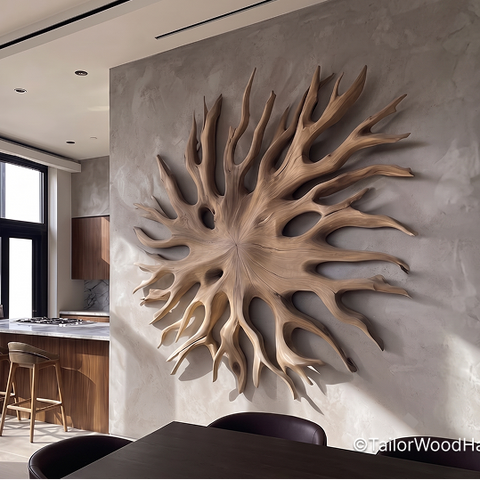
Whenever possible, store wall art standing upright rather than laid flat, since anything stacked on top of a flat piece adds weight and pressure that can warp, crease, or crack it over time. This vertical storage rule is especially crucial for substantial architectural pieces like the Reclaimed Wall Art – Rustic Reclaimed Wall Art Made from Salvaged Wood, Handcrafted where standing them upright protects the structural integrity of the heavy wood.
If a piece has to be stored flat due to space constraints, keep the stack shallow and avoid placing anything heavy on top, and use a rigid surface underneath rather than letting it rest on something soft or uneven. A simple wall-mounted rack, a gridwall panel, or even a few pieces leaned carefully against a wall with padding between them works well for upright storage.
Preventing structural damage by keeping artwork in a vertical position
Keep Everything Off the Floor
Elevate stored art off the floor using a shelf, riser, or even a few sturdy boxes underneath, particularly if the floor is concrete or in a space prone to any dampness. Concrete floors especially can hold moisture that seeps upward into anything resting directly on them, even in a room that otherwise feels dry.
Elevating boxes to protect against moisture seeping up from the ground
Label and Track What You've Stored
A simple label on each box or wrapped piece noting what's inside and which season it belongs to saves a lot of guesswork later, especially if you're rotating several sets of seasonal art throughout the year. A basic inventory list, even just a few lines in a notes app, makes it easy to confirm everything is accounted for and helps you spot anything that might be missing before the season it belongs to rolls back around.
Organizing your collection for quick and stress-free seasonal rotations
Tips for Better Seasonal Wall Art Storage
-
Check on stored pieces periodically, even during the off-season, so any developing issue like mold, warping, or pest damage gets caught early rather than discovered right before you need the piece again
-
Avoid plastic wrap directly against the surface of a piece, since trapped moisture underneath plastic can encourage mold growth over long storage periods; breathable fabric or acid-free paper is a safer choice
-
Group pieces by season in separate, clearly labeled containers rather than mixing everything together, so swapping decor each season is quick rather than a full sorting project
-
Remove wire hangers or hardware that could scratch adjacent pieces if storing several items together in the same container
-
Keep a dedicated, consistent storage spot rather than scattering seasonal pieces across multiple locations, which makes it far easier to check on everything at once
Pro advice for maintaining your artwork while it waits for its season
Frequently Asked Questions About Storing Seasonal Wall Art
A few questions come up often once people start thinking seriously about protecting art that only comes out part of the year.
Is it okay to store wall art in the garage or attic?
It's best avoided if possible. Garages and attics typically see much bigger temperature and humidity swings than the rest of a home, which puts stored art at higher risk of warping, fading, or mold over time. A climate-controlled closet or spare room inside the main living space is a safer choice.
How long can wall art safely stay in storage?
There's no strict time limit as long as storage conditions stay stable, but it's worth periodically checking on pieces even during long storage stretches, roughly every few months, to catch any early signs of damage before they become bigger problems.
Do wood or dimensional pieces need different storage than framed prints?
Yes, to some degree. Dimensional or textured pieces benefit from extra padding around any raised or protruding sections, since pressure on those areas is more likely to cause damage than on a flat surface.
When packing intricate, multi-layered items like the Layered Strata Wood Wall Panel for Organic Modern Interiors, ensure all carved edges and protruding details are fully cushioned with bubble wrap. Wood pieces also do best in a space with stable humidity, since swings in moisture can cause warping over time even while the piece is safely stored.
What's the best material to wrap wall art in for storage?
Acid-free tissue paper or a soft, breathable cloth as an inner layer, followed by bubble wrap for cushioning, is a safe combination for most pieces. Avoid wrapping directly in plastic, which can trap moisture against the surface during long storage periods.
>>> Read more: How to Make Reclaimed Wood Wall Art: Step-by-Step for Beginners
Storing seasonal wall art properly isn't complicated, but it does take a bit more care than tossing pieces in a box and shutting a closet door. Clean each piece before it goes away, wrap it thoughtfully, keep it upright and off the floor in a climate-stable spot, and check on it now and then while it waits for its season to come back around. A little consistency here is what keeps a rotating decor collection looking just as good year after year, rather than showing wear a little more with each round of storage.
Looking for pieces sturdy enough to stay up year-round instead of rotating in and out of storage? Visit Tailor Wood Haven to explore our full range of handcrafted wood wall art, or browse the Carved Wood Wall Art, Driftwood Wall Art, and Wood Wall Art collections for durable pieces built to stay on display.
|
TAILOR WOOD HAVEN
Address 1: 412 Palmetto Dr, Columbia, SC 29201
Address 2: 1201 Hillside Avenue, Victoria, British Columbia V8T 2B1, Canada
Address 3: Phu Thai Town, Hai Phong 03306, Vietnam
Call us: +1 (647)-608-1571
Email: hello@tailorwoodhaven.com
|
 Skip to content


 Farmhouse Floating Shelves – Perfect handcrafted furniture
 Farmhouse Narrow Console Table with Storage for Entryway or Living Room
 Custom Rustic Console – Natural Wood, Made to Order