Protecting wood wall art from moisture is less about understanding why humidity affects wood, and more about having the right tools and habits in place to actually manage it day to day. This guide skips the background theory and goes straight to the practical side: how to measure what you're actually dealing with, which physical barriers and mounting techniques reduce moisture exposure, which tools genuinely help, and what to do if a piece gets wet unexpectedly.
Measure Before You Try to Fix Anything
Guessing at humidity levels leads to either overreacting or missing a real problem, so start with an actual reading.
-
A basic hygrometer, available cheaply at most hardware stores, gives you a real humidity percentage for the room instead of a guess, and placing one near a valuable piece specifically, rather than relying on a whole-house reading, catches localized issues a central thermostat sensor would miss
-
A pinless moisture meter, a step up in cost but worth it for a valuable or antique piece, reads the actual moisture content of the wood itself rather than just the surrounding air, giving a much more direct picture of whether a piece is at risk
-
Track readings over a few weeks, not just once, since a single measurement doesn't tell you whether conditions are stable or swinging, and it's the swings that cause the most damage
Utilizing hygrometers and pinless meters to track exact ambient moisture levels accurately
Physical Barriers and Mounting Techniques
A few physical changes to how a piece is mounted and backed reduce moisture exposure more directly than general humidity control alone.
Add a Vapor Barrier Behind the Piece
A thin sheet of plastic sheeting or a specialized vapor barrier material placed between a wood piece and the wall itself blocks moisture migrating out of the wall from reaching the back of the art directly. This matters most on exterior walls, which tend to run cooler and can develop condensation on their interior surface in humid conditions, moisture that would otherwise transfer directly into anything mounted flush against them.
Mount with a Standoff for Airflow
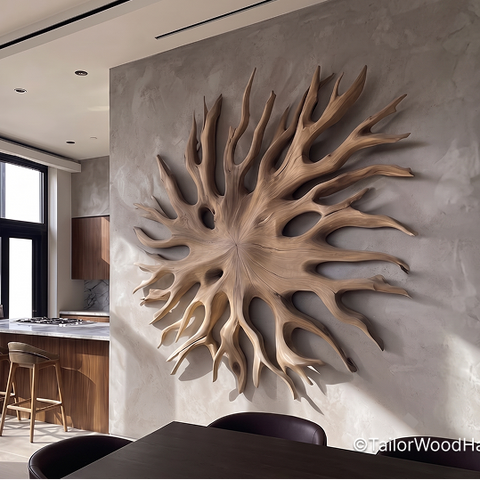
Rather than mounting a piece flush against the wall, a standoff mount, using small spacers or cleats that hold the piece an inch or so off the surface, allows air to circulate behind it rather than trapping a pocket of stagnant, potentially humid air between the wood and the wall. This small gap makes a meaningful difference for pieces on walls that run cooler or damper than the rest of the room, and it matters even more for a dimensional, sculptural piece like this organic wall sculpture, where recessed areas behind the raised form can trap moisture if mounted completely flush.
Using recessed cleats to create protective ventilation gaps behind dimensional sculptures
>>> Read more: How to Arrange Art on a Wall – Discover Full Guidance
Use Moisture-Absorbing Packets Nearby
Silica gel packets or a small moisture-absorbing product, the kind used in closets or storage containers, placed discreetly behind or near a piece in an enclosed or poorly ventilated space can pull excess ambient moisture out of the immediate air pocket around the art. This is a particularly useful, low-cost measure for a piece stored temporarily in a box or closet rather than actively displayed, where airflow is more limited than in an open room.
Beyond the piece itself, a few tools manage the room's overall moisture level more directly than passive habits alone.
Dehumidifiers
A dehumidifier sized appropriately for the room, most units list a capacity in pints per day matched to square footage, keeps ambient humidity within a safer range during particularly damp seasons or in naturally humid climates. For a room with valuable wood pieces, running a dehumidifier to keep readings consistently in the 30 to 50 percent range is more effective than relying on general home HVAC alone, which isn't always tuned to that specific target. This is especially worth doing for a deeply carved piece, like something from a carved wood wall art collection, where the recessed grooves of the design give humid air more surface area to settle into than a flat panel would.
Exhaust Fans and Ventilation
In rooms prone to humidity spikes, bathrooms, kitchens, laundry areas, or basements, a functioning exhaust fan run consistently during and after activities that generate moisture, showers, cooking, laundry, clears humid air before it has a chance to settle into nearby surfaces, including any wood wall art hanging in or near that space. A small circulating fan in a room without active exhaust ventilation also helps prevent humid air from stagnating in one spot, like a corner or a poorly ventilated alcove.
Clearing steam rapidly from bathrooms and kitchens to prevent airborne moisture settling
Placement Choices That Avoid Moisture-Prone Spots
Some locations in a home are simply harder on wood regardless of how well a piece is otherwise protected, and avoiding them outright is often easier than compensating for them.
-
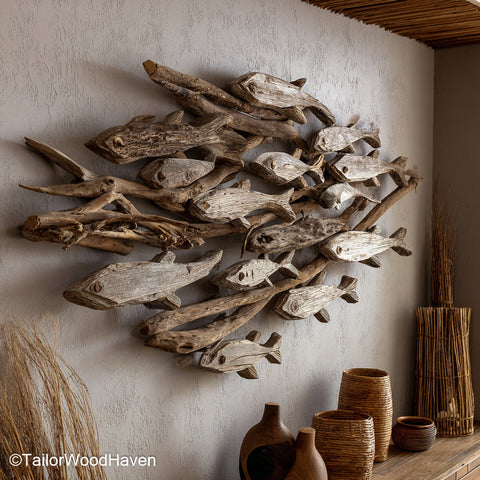
Basements, especially unfinished or minimally conditioned ones, tend to run both cooler and more humid than the rest of a home, making them a riskier default location for a valuable piece unless the space has active dehumidification. Naturally weathered material, like the pieces in a driftwood wall art collection, tends to tolerate this kind of fluctuating environment somewhat better than freshly milled lumber, since the wood has already been through extensive moisture cycling before being finished into art
-
Garages and enclosed porches see some of the widest temperature and humidity swings in a typical home, since they're only partially conditioned, if at all
-
Walls directly behind plumbing, like a wall shared with a bathroom or kitchen, can run slightly damp even without any visible leak, simply from ambient moisture in the adjoining room
-
Areas near exterior doors, which see regular temperature and humidity shifts every time the door opens, are a less stable choice than an interior wall further from entry points

Identifying and avoiding risky basements enclosed porches and plumbing-adjacent walls completely
What to Do If a Piece Gets Wet
Even with good prevention in place, an unexpected spill, leak, or flood can still happen, and how quickly you respond matters more than almost anything else for the outcome.
-
Remove the piece from the wet area immediately if there's any ongoing leak or flooding risk, rather than leaving it in place hoping the water recedes
-
Blot, don't rub, any visible surface moisture with a clean, dry cloth to remove as much standing water as possible right away
-
Dry the piece slowly at room temperature, away from direct heat sources or sunlight, since rapid forced drying can cause new cracking on top of whatever moisture damage already occurred
-
Increase air circulation around the piece during drying, a fan positioned nearby, without pointing it in a way that would dry one side much faster than the other
-
Once fully dry, inspect for new warping, cracking, or lifted finish, and address anything found with the appropriate repair or refinishing steps before rehanging
>>> Read more: How to Clean Driftwood Wall Art: Safe Maintenance & Care Guide
Protecting wood wall art from moisture is largely a matter of having the right tools in place and using them consistently, a hygrometer to actually know your conditions, physical barriers and standoff mounting to reduce direct exposure, a dehumidifier or exhaust fan where the room genuinely needs one, and a clear, fast response plan if a piece does get wet unexpectedly. A piece like this radiating driftwood sculpture, finished and sealed with exactly these conditions in mind, shows how much of this protection can already be built in before a piece ever reaches your wall. None of these measures require much ongoing effort once they're set up, and together they do far more for a piece's long-term condition than hoping humidity simply stays manageable on its own. If you're shopping with a damp room or humid climate in mind, the team at Tailor Wood Haven can also walk you through exactly how a specific piece was sealed before you buy.
|
TAILOR WOOD HAVEN
Address 1: 412 Palmetto Dr, Columbia, SC 29201
Address 2: 1201 Hillside Avenue, Victoria, British Columbia V8T 2B1, Canada
Address 3: Phu Thai Town, Hai Phong 03306, Vietnam
Call us: +1 (647)-608-1571
Email: hello@tailorwoodhaven.com
|
 Skip to content


 Farmhouse Floating Shelves – Perfect handcrafted furniture
 Farmhouse Narrow Console Table with Storage for Entryway or Living Room
 Custom Rustic Console – Natural Wood, Made to Order