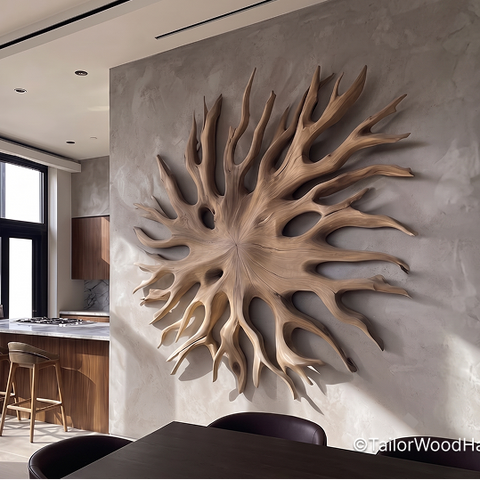
Not every piece of wood wall art automatically becomes the center of attention in a room, even a beautiful one. Whether a piece reads as a true focal point or just another item on the wall comes down to a handful of deliberate choices: how big it is relative to the wall, where exactly it hangs, what's behind and around it, and how it's lit. Here's how to set a wood piece up to genuinely anchor a room rather than blend into it.
Why Some Wall Art Becomes a Focal Point and Some Doesn't
A focal point works by giving the eye a clear place to land first when entering a room, and everything else in the space either supports that point or competes with it. A piece can be objectively stunning and still fail to become a focal point if it's undersized for its wall, hung somewhere with poor sightlines, surrounded by too much competing visual noise, or lit flatly enough that its texture and detail don't register. The techniques below all work by removing that competition and clearing a path for the eye to land where you want it.
Understanding the difference between an eye-catching statement and background decor
Techniques for Making a Wood Piece the Focal Point
A few specific, practical adjustments make the biggest difference in whether a wood piece reads as a room's centerpiece.
Choose the Right Scale
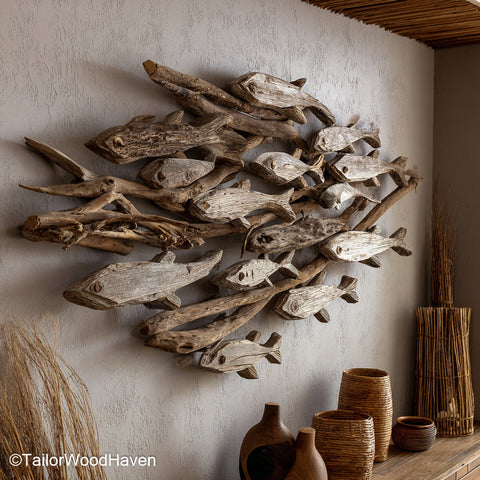
Undersized art is one of the most common reasons a piece fails to become a focal point, since a small piece on a large, empty wall reads as an afterthought rather than a statement. As a general guide, a focal wood piece should span at least half, and ideally closer to two-thirds, of the width of the furniture or wall section it's associated with. For expansive empty walls, opting for a sprawling, multi-element design like the School of Driftwood Fish Wall Art for Coastal Interiors ensures the art commands the necessary visual weight to anchor the space. When scaling up feels like too big a commitment, a tightly grouped arrangement of two or three pieces can achieve a similar visual weight to one large piece, as long as they're hung close enough together to read as a single composition rather than scattered individual items.
Selecting properly sized art so it anchors the space instead of getting lost
>>> Read more: Large Driftwood Wall Art: Statement Organic Pieces for Expansive Walls
Pick a Wall with a Strong Sightline
The wall directly opposite a room's main entrance, or the first wall visible from an adjoining hallway, naturally draws more attention than a wall you only see once you're already deep inside the room. Hanging a focal wood piece on whichever wall is visible immediately upon entering gives it a head start on becoming the room's centerpiece, since it's the first thing registered before anything else in the space competes for attention.
Use Wall Color as Contrast
A wood piece surrounded by a wall color that closely matches its tone can visually blend in rather than stand out, even at a large scale. Painting the wall behind a focal piece in a color that contrasts, a deep, saturated shade behind a lighter piece, or a soft neutral behind a darker, richer wood tone, creates the kind of visual separation that makes a piece pop rather than recede into its background. This doesn't require repainting an entire room, either; a single accent wall behind the piece is enough to create the contrast without committing the whole space to a bold color.
Painting an accent wall to create visual separation and make the wood tone pop
Light It Deliberately
Flat, even overhead lighting is one of the fastest ways to flatten out a wood piece's texture and grain, undercutting exactly the depth that makes it interesting to look at. A dedicated picture light mounted above the piece, or an angled floor or table lamp nearby, throws light across the surface at an angle rather than straight on, which is what actually reveals grain, carving depth, and shadow. A piece that reads as flat and unremarkable under standard room lighting can look dramatically more dimensional and worthy of attention once it's properly lit.
Anchor It with Symmetrical Furniture
Furniture arranged symmetrically around or beneath a piece, a sofa centered below it, matching side tables or lamps flanking it, reinforces the sense that everything in the room is oriented toward that one point. This works exceptionally well for distinctive, centrally balanced statement pieces like the Handcrafted Driftwood Deer Head Wall Sculpture, where symmetrical flanking instantly elevates it to the room's main event. Asymmetrical or off-center furniture placement relative to the art can undercut its focal status even when the piece itself is large and well-lit, since the eye picks up on the mismatch between where the furniture is centered and where the art actually hangs.
Arranging sofas and tables to reinforce the artwork's central position
When to Isolate the Piece vs Incorporate It Into a Gallery
A wood piece intended as a true focal point generally benefits from more isolation than incorporation, meaning it works best with clear, uncluttered wall space around it rather than being surrounded by several other smaller pieces competing for the same attention. That said, a focal piece can still anchor a broader gallery wall as long as it's clearly the largest and most dominant element, with supporting pieces smaller in scale and given generous spacing, rather than packed in tightly enough to compete on equal visual footing.
If you're unsure which approach suits your space, a simple test helps: stand at the room's entrance and notice where your eye goes first. If a surrounding gallery arrangement pulls attention away from the intended focal piece rather than toward it, thinning out the nearby pieces or increasing the spacing between them usually restores the piece's status as the clear centerpiece.
Deciding whether to give the art breathing room or surround it with supporting pieces
>>> Read more: How to Match Wood Wall Art with Furniture: A Complete Wood Tone Guide
Common Mistakes That Undercut a Focal Piece
-
Undersizing the piece relative to its wall or furniture — a focal piece needs enough scale to command the space it's meant to anchor
-
Hanging it somewhere with a weak sightline — a piece tucked around a corner or on a wall only visible once you're already seated works far less effectively as a focal point than one visible immediately upon entering the room
-
Letting wall color blend into the piece's tone — insufficient contrast between wall and art makes even a well-placed, well-sized piece harder to notice
-
Crowding it with competing decor — too many nearby pieces of similar visual weight divide attention rather than reinforcing the intended focal point
-
Relying on flat, overhead lighting alone — texture and depth in wood need angled light to read clearly, and skipping this step leaves a piece looking flatter and less compelling than it actually is
Identifying layout and lighting errors that distract from your main statement
Frequently Asked Questions About Making Wood Wall Art a Focal Point
A few questions come up often once people start planning a room around a single statement piece.
Does the piece need to be large to work as a focal point?
Size helps, but it's relative to the wall and furniture around it rather than an absolute number. A smaller piece can still function as a focal point on a smaller wall or in a more intimate room, as long as it's appropriately scaled to its surroundings and given enough breathing room.
What if I can't repaint the wall for contrast?
A contrasting rug, an accent piece of furniture, or even a large mat or shadow box border around the art can create a similar visual separation without needing to repaint. Lighting also does a lot of the work here, since a well-lit piece stands out even against a wall that doesn't offer much color contrast.
Can more than one piece function as a focal point in the same room?
Generally, a room reads more clearly with a single primary focal point per major sightline, though a large open-concept space can sometimes support two, as long as they're positioned in different zones of the room rather than competing within the same immediate view.
Is a picture light really necessary?
It's not strictly necessary, but it makes a measurable difference for any piece with real texture or carved detail, since angled light reveals depth that flat lighting flattens out. A well-positioned lamp nearby can often achieve a similar effect if a dedicated picture light isn't practical.
How do I know if my current wall art is working as a focal point?
Stand at the entrance to the room and notice where your eye lands first without deliberately searching for the art. If it takes a moment to find, or if your eye is drawn to competing furniture, clutter, or other decor first, the piece likely needs more scale, better lighting, more contrast, or more surrounding space to function as a true focal point.
Making wood wall art a genuine focal point comes down to giving it every advantage: the right scale for its wall, a strong sightline, enough contrast to stand out, deliberate lighting that reveals its texture, and furniture arranged to reinforce rather than compete with it. None of these adjustments require major renovation, but together they're the difference between a beautiful piece that blends into the background and one that genuinely anchors a room.
Looking for a wood wall art piece with enough presence to become your room's focal point? Visit Tailor Wood Haven to explore our full range of handcrafted wood wall art, or browse the Carved Wood Wall Art, Driftwood Wall Art, and Wood Wall Art collections for statement pieces built to anchor a room.
|
TAILOR WOOD HAVEN
Address 1: 412 Palmetto Dr, Columbia, SC 29201
Address 2: 1201 Hillside Avenue, Victoria, British Columbia V8T 2B1, Canada
Address 3: Phu Thai Town, Hai Phong 03306, Vietnam
Call us: +1 (647)-608-1571
Email: hello@tailorwoodhaven.com
|
 Skip to content


 Farmhouse Floating Shelves – Perfect handcrafted furniture
 Farmhouse Narrow Console Table with Storage for Entryway or Living Room
 Custom Rustic Console – Natural Wood, Made to Order