A striking piece of wood wall art can anchor an entire room, but only if everything around it is arranged to support it rather than compete with it. Decorating around a piece like this is less about matching every other detail to the wood and more about giving it room to be the focal point, then building color, furniture, and lighting decisions outward from there. Here's how to approach a room with a wood wall art centerpiece already in mind, or already on the wall.
Start with the Wood Piece as Your Color Anchor
Before choosing paint colors, furniture fabric, or accessories, look closely at your wood piece's undertone, warm honey and amber tones, cooler gray-washed tones, or a neutral driftwood palette, and let that guide the room's broader color scheme rather than treating it as an afterthought. A warm-toned piece pairs naturally with earthy neutrals, terracotta, cream, and olive, while a cooler-toned piece suits grays, navy, and sage more comfortably. Pulling one or two colors directly from the wood piece, even subtly, into a throw pillow, a rug, or a paint color creates a sense that the room was built around the art rather than the art being added in after the fact.
Using your artwork's natural undertones to guide the room's broader palette
>>> Read more: How to Make Textured Wall Art: A Step-by-Step DIY Guide
Building the Room Around the Piece
Once you know the color direction, a few practical decisions about furniture, lighting, and nearby surfaces determine whether the piece actually reads as a focal point once the room is finished.
Choosing Furniture and Placement
Position major furniture, a sofa, a bed, a console table, in a way that leaves the wood piece clearly visible and not visually blocked or crowded by tall furniture backs or floor lamps directly in front of it. As a general sizing guide, wall art works best when it spans roughly two-thirds to three-quarters of the width of the furniture it hangs above, so a large wood piece calls for a substantial piece of furniture beneath it rather than something narrow and undersized that leaves it floating awkwardly.
Keep furniture upholstery and finishes in a supporting role rather than a competing one. If the wood piece is highly textured or visually busy, simpler, more solid-colored furniture nearby lets it stand out. If the piece is more minimal and smooth, the surrounding furniture has a bit more room to introduce pattern or texture without overwhelming the composition.
Sizing and positioning your furnishings to complement the wall art beautifully
Lighting to Highlight the Piece
Lighting does more for a wood piece than almost any other styling decision, since wood's grain and texture only really show up when light hits it well. A picture light mounted just above the piece is the most direct way to highlight it, casting light down across the surface and bringing out grain variation that flat overhead lighting tends to flatten out. Where a dedicated picture light isn't practical, positioning a floor or table lamp nearby, angled so its light grazes across the piece rather than hitting it straight on, achieves a similar effect and adds warmth to the whole wall in the evening.
Avoid placing wood wall art directly across from a large window that gets strong, direct sun for much of the day, since prolonged UV exposure fades wood tone over time. Indirect, ambient natural light during the day, supplemented by a picture light or lamp in the evening, keeps the piece looking its best without the fading risk.
Styling the Surface Below It
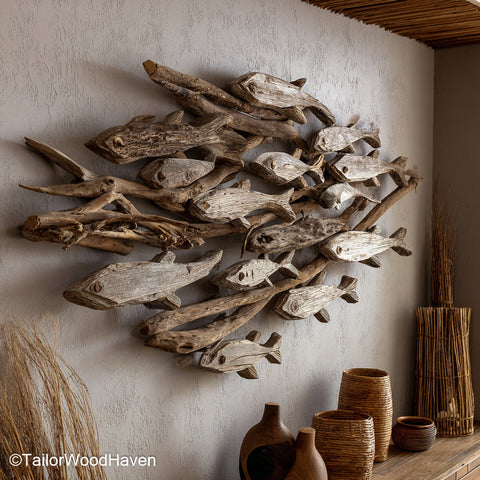
Whatever furniture or surface sits beneath the wood piece, a console table, a mantel, a dresser, benefits from restrained styling rather than a cluttered arrangement that competes with the art above it. A single well-chosen object, a ceramic vase, a small stack of books, a low bowl, gives the eye somewhere to land without pulling focus away from the wall. If you are decorating beneath a striking, figurative piece like the Driftwood Horse Head Wall Sculpture in Natural Wood, keep any styled objects on that surface in a complementary tone to the wood piece rather than a jarring, unrelated color. Leave visible empty space on the surface rather than filling every inch, since a bit of negative space below the piece actually makes it feel more intentional, not less.
Curating minimal and complementary decor to avoid competing with your art
Balancing Negative Space Around the Piece
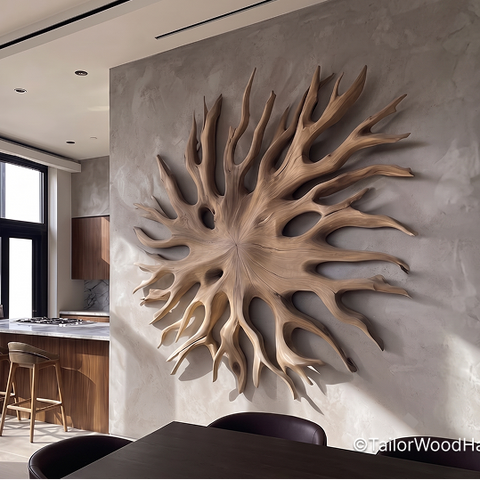
One of the most common mistakes in decorating around a large wood wall art piece is surrounding it too tightly with other decor, additional smaller art, shelving, or wall-mounted objects crowded in close on either side. Wood wall art, especially anything massive and sculptural like the Oversized Sunburst Driftwood Wall Art in Natural Wood, needs breathing room to read clearly as its own statement. Leaving a reasonable amount of open wall space around the piece, rather than filling every available inch, actually draws more attention to it, not less, since the eye has a clear, uncluttered path to the art rather than competing visual information nearby.
If you do want to build out a fuller gallery arrangement around the piece, keep the wood art as the largest and most dominant element, with any supporting pieces smaller in scale and positioned with generous spacing, generally at least a few inches, rather than packed in edge to edge.
Giving dimensional and sculptural artwork the breathing room it needs to stand out
Common Mistakes When Decorating Around Wood Wall Art
-
Choosing the piece last — picking paint colors, furniture, and rugs first and then trying to force a wood piece to fit into an already-finished room is far harder than starting with the wood piece's undertone as the anchor
-
Overlighting or underlighting the piece — flat overhead lighting alone often fails to bring out wood grain and texture, while too many competing light sources can wash out the effect just as easily
-
Crowding the piece with other decor — packing shelves, other art, or accessories too close to a large wood piece takes away from its impact as a focal point
-
Ignoring scale relative to furniture — a wood piece that's too small for the furniture beneath it, or too large for a narrow wall, throws off the proportion of the whole arrangement
Identifying frequent styling errors that diminish the impact of your decor
>>> Read more: How to Mix Wood Wall Art with Other Decor: A Layering Guide
Frequently Asked Questions About Decorating Around Wood Wall Art
A few questions come up often once people start planning a room around a wood wall art piece.
What wall colors work best behind wood wall art?
Warm neutrals, soft whites, and earthy tones tend to let wood grain and texture stand out without competing with it, while a bold, saturated wall color can work too if it's chosen from the same color family as the wood piece's undertone rather than clashing against it.
Should I match my furniture to the wood piece exactly?
No. Matching undertone, warm versus cool, matters more than matching exact wood species or color, and furniture doesn't need to be wood at all to complement a wood wall art piece, since upholstered or metal furniture can pair just as well if the overall color palette relates well.
How much empty wall space should surround a large wood piece?
There's no strict measurement, but leaving noticeably more open space around a large or dimensional wood piece than you would around a small framed print helps it read clearly as a focal point rather than getting lost among other nearby decor.
Does lighting really make a visible difference for wood wall art?
Yes, more than most people expect. Grain, texture, and depth in carved or dimensional wood pieces are especially dependent on light angle, so a piece that looks flat under standard overhead lighting can look dramatically more dimensional with a picture light or angled lamp nearby.
Can I decorate around wood wall art in a very modern, minimalist room?
Yes. A simple, smooth wood piece works particularly well in a minimalist space, since its natural texture adds warmth without introducing visual clutter, and the restrained styling that minimalist rooms already favor pairs naturally with the "give it room to breathe" principle that wood wall art benefits from anyway.
Decorating around wood wall art works best when the piece leads the design decisions rather than getting squeezed in after everything else is chosen. Let its undertone guide your color palette, size furniture and lighting to support it rather than compete with it, and resist the urge to crowd it with too much additional decor. Handled this way, a single wood piece can genuinely set the tone for an entire room.
Looking for a wood wall art piece to build your next room around? Visit Tailor Wood Haven to explore our full range of handcrafted wood wall art, or browse the Carved Wood Wall Art, Driftwood Wall Art, and Wood Wall Art collections for a centerpiece worth designing a whole room around.
|
TAILOR WOOD HAVEN
Address 1: 412 Palmetto Dr, Columbia, SC 29201
Address 2: 1201 Hillside Avenue, Victoria, British Columbia V8T 2B1, Canada
Address 3: Phu Thai Town, Hai Phong 03306, Vietnam
Call us: +1 (647)-608-1571
Email: hello@tailorwoodhaven.com
|
 Skip to content


 Farmhouse Floating Shelves – Perfect handcrafted furniture
 Farmhouse Narrow Console Table with Storage for Entryway or Living Room
 Custom Rustic Console – Natural Wood, Made to Order