A single piece of wood wall art can anchor a wall on its own, but most well-designed rooms actually mix wood alongside other materials, mirrors, framed prints, woven textiles, metal accents, rather than relying on wood art alone. Done well, that mix adds real depth and visual interest. Done carelessly, it can start to feel busy or disconnected. Here's how to combine wood wall art with other decor in a way that reads as intentional rather than random.
Why Mix Wood Wall Art with Other Decor
Wood alone brings warmth and texture, but it tends to sit in a fairly narrow visual range, similar tones, similar organic shapes. Introducing other materials breaks up that range and gives a wall more dimension: a mirror adds reflectivity and light, a framed print adds flat color and pattern, a woven textile adds softness, and metal adds a cool, structured contrast. The goal isn't to compete with the wood piece, it's to build a small ecosystem of materials that each contribute something the others don't.
Discover how blending different materials adds depth and prevents a flat design
Principles for Mixing Wood Wall Art with Other Materials
A few underlying rules make almost any combination of materials work together, regardless of the specific pieces involved.
Balance Texture, Not Just Material
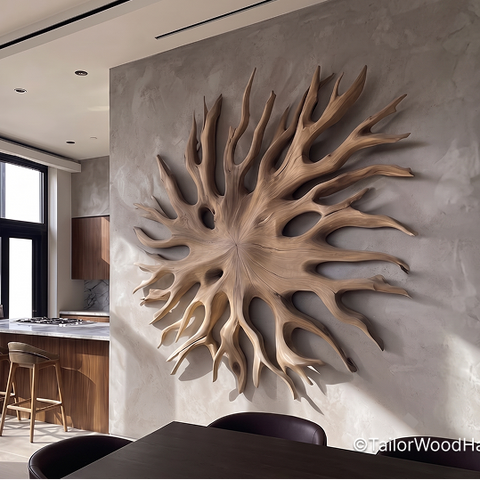
Every material carries its own texture, wood grain, glass smoothness, woven fiber, matte metal, and a mixed wall works best when there's a deliberate balance rather than everything competing for the same kind of attention. If your wood piece is heavily textured, like the intricately designed Handcrafted Spiral Driftwood Wall Art for Feature Walls, pair it with smoother, quieter neighbors, a simple framed print, a plain mirror, so the wood piece stays the visual focal point rather than getting lost among equally busy neighbors. If your wood piece is smooth and minimal, it can handle sitting next to something bolder, like a patterned textile or a sculptural metal piece, without the wall feeling overloaded.
Pairing rough wood grain with smooth glass or soft fabrics for contrast
Use Color as the Connective Thread
Materials don't need to match, but a shared color note ties a mixed wall together far more effectively than matching materials would. A wood piece with warm undertones pairs naturally with a mirror in a warm brass frame, a framed print with earthy tones, or a textile in rust, cream, or olive. Pick one or two colors present in your wood piece, even subtly, and look for that same note repeated somewhere in each of the other pieces you're pairing with it.
Vary Scale and Shape
A wall mixing several types of decor benefits from variety in size and silhouette, not just material. Pairing your wood piece, whatever its shape, with items of a similar scale but a different outline, a round mirror next to a rectangular wood panel, an organic woven hanging next to a geometric wood piece, creates visual rhythm rather than a repetitive, matched-set feeling. Avoid pairing several same-sized, same-shaped pieces side by side, even in different materials, since that tends to read as a mismatched set rather than an intentional mix.
Combining round mirrors and rectangular panels to create visual rhythm
>>> Read more: How to Make Wall Art Look Nice in a Bedroom
Pairing Wood Wall Art with Specific Decor Types
Different decor categories bring their own considerations when paired alongside wood.
Mirrors
A mirror is one of the easiest pieces to pair with wood wall art, since it introduces light and reflectivity that wood alone can't offer, and a mirror's frame, whether wood, metal, or unframed, gives you an easy way to either match or intentionally contrast with your wood piece's tone. A wood-framed mirror in a similar undertone reinforces the wood piece, while a metal-framed mirror introduces the kind of material contrast that keeps a grouping from feeling monotone.
Introducing light and reflectivity to complement organic wood tones
Framed Prints and Photography
Framed prints and photography add flat color and pattern that a dimensional wood piece typically doesn't provide on its own. Choosing a print with a color palette that echoes your wood piece's tone, earthy neutrals, warm rust, deep green, keeps the pairing cohesive even though the mediums are completely different. A simple black or wood-toned frame on the print usually integrates more smoothly with a wood wall piece than an ornate gold or white frame would, which can pull focus in a different stylistic direction.
Textiles and Woven Wall Hangings
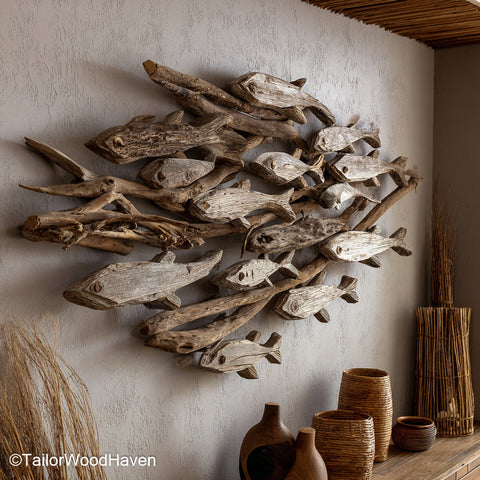
Macrame, woven tapestries, and fabric wall hangings share an organic, handmade quality with a lot of wood wall art, which makes them a natural pairing, particularly in boho or eclectic-leaning rooms. Since both textiles and wood can bring a lot of texture on their own, keep one of the two relatively simple if you're hanging them close together. For example, you might place a heavily fringed macrame piece next to a smooth, minimal wood panel, or balance a highly dimensional, earthy piece like the Suspended Driftwood Hanging Wall Art in Natural Wood next to a simpler, plainer weave to keep the wall from feeling too visually heavy.
Leaning into a cozy boho aesthetic with fabrics and macrame
Metal introduces a cool, structured counterpoint to wood's warmth and organic shape, and the contrast between the two materials is often what makes a mixed wall feel intentional rather than accidental. A matte black metal piece works particularly well next to wood, since the dark, flat finish doesn't compete with wood's natural variation the way a shiny, reflective metal might. Repeating the same metal finish in nearby hardware, a lamp, drawer pulls, picture hooks, helps tie a wood-and-metal pairing together even further.
Using matte black or brass structured pieces for a cool industrial contrast
Plants and Greenery
Living or faux greenery softens a wall arrangement and adds a layer that neither wood nor any framed piece can replicate. A trailing plant or a simple wall-mounted planter positioned near, but not directly overlapping, a wood piece adds life to the grouping without competing with it for visual attention. Keep planters and pots in a neutral material, terracotta, dark ceramic, so the greenery itself becomes the accent rather than a busy patterned pot doing the same job the wood piece is already doing.
Building a Mixed Gallery Wall
Combining wood wall art with several other decor types at once, rather than just one or two companion pieces, takes a bit more planning to avoid the wall feeling cluttered.
Lay every piece out on the floor first, arranging and rearranging until the balance of texture, color, and scale feels right before committing to any nail holes. Let one piece, often the wood piece if it's the largest or most textural, act as the visual anchor, with everything else arranged to support it rather than compete with it for attention. Keep consistent spacing, generally 2 to 3 inches between framed pieces, even while mixing materials and shapes, since consistent spacing is one of the biggest things that makes a mixed wall read as curated rather than haphazard.
A few common mistakes are worth watching for. Overcrowding a mixed wall with too many high-texture pieces at once, several heavily carved, woven, or richly patterned items packed close together, tends to look chaotic rather than layered, so it helps to include a few visually quieter pieces as breathing room between the busier ones. Ignoring color entirely and mixing purely by material can also leave a wall feeling scattered, even when the individual pieces are each attractive on their own, so it's worth double-checking that some color thread runs through the whole grouping before finalizing the layout.
Planning your layout to ensure a curated rather than cluttered look
>>> Read more: How to Match Wood Wall Art with Furniture: A Complete Wood Tone Guide
Frequently Asked Questions About Mixing Wood Wall Art with Other Decor
A few questions come up often once people start planning a mixed wall display.
How many different materials can I mix on one wall?
Two to four materials, wood plus a mirror and a textile, for example, tends to feel intentional, while five or more different materials in one grouping can start to feel busy unless the color palette and scale are very carefully controlled.
Does the wood piece need to be the centerpiece?
Not necessarily, but it helps to have one clear focal point in any mixed arrangement, whether that's the wood piece or something else, rather than letting every item compete equally for attention. A single dominant piece with supporting elements around it almost always reads better than a wall of equally weighted items.
Can I mix wood wall art with modern, minimalist decor?
Yes. A simple, smooth wood piece pairs particularly well with minimalist decor, since its natural texture adds warmth without introducing visual clutter, especially alongside clean-lined metal or glass accents.
What if my wood piece and other decor don't share any color at all?
Look for the smallest shared note rather than an obvious match, a warm undertone in a mostly neutral print, or a similar depth of color even across different hues. If nothing connects at all, a neutral bridging element, a mat board, a frame color, or a small styled object placed between them, can help tie the grouping together.
Should I match the frame finishes across mixed pieces?
Not necessarily, but repeating one frame or hardware finish, black metal, natural wood, brass, across at least two or three pieces in the grouping creates a sense of cohesion even when the materials themselves vary quite a bit.
Mixing wood wall art with other decor comes down to balancing texture, finding a shared color thread, and varying scale and shape enough to create visual rhythm rather than repetition. Wood brings warmth and organic texture that pairs naturally with the reflectivity of a mirror, the flat color of a print, the softness of a textile, or the structure of metal, as long as the combination is planned with a bit of intention rather than assembled at random. Get that balance right, and a mixed wall ends up feeling more collected and personal than any single-material display could on its own.
Looking for a wood wall art piece to build a mixed display around? Visit Tailor Wood Haven to explore our full range of handcrafted wood wall art, or browse the Carved Wood Wall Art, Driftwood Wall Art, and Wood Wall Art collections for a centerpiece that pairs beautifully with mirrors, textiles, and metal accents alike.
|
TAILOR WOOD HAVEN
Address 1: 412 Palmetto Dr, Columbia, SC 29201
Address 2: 1201 Hillside Avenue, Victoria, British Columbia V8T 2B1, Canada
Address 3: Phu Thai Town, Hai Phong 03306, Vietnam
Call us: +1 (647)-608-1571
Email: hello@tailorwoodhaven.com
|
 Skip to content


 Farmhouse Floating Shelves – Perfect handcrafted furniture
 Farmhouse Narrow Console Table with Storage for Entryway or Living Room
 Custom Rustic Console – Natural Wood, Made to Order