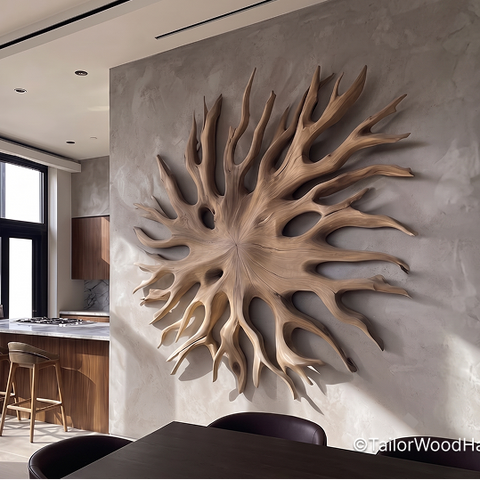
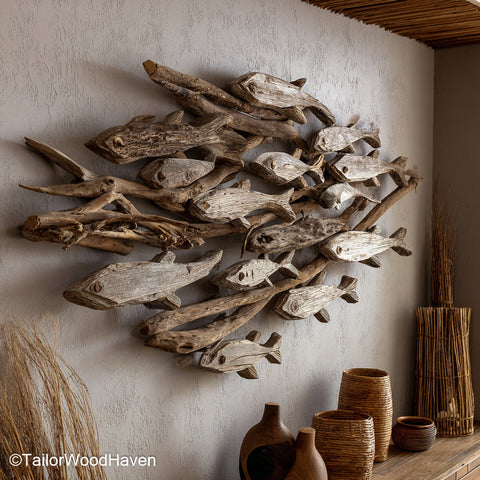
Have you ever wondered what makes weathered pieces of wood washed ashore by the ocean so captivating? More than just an interior design trend, driftwood art embodies a raw, organic beauty shaped by nature over time, along with fascinating stories of survival throughout history. This article explores the world of driftwood art, from its origins and one-of-a-kind value to practical tips for choosing a high-quality piece.

Driftwood art
1. Definition and origins of driftwood art
Driftwood art is more than a distinctive form of interior decoration. It also carries a long and fascinating history. The following section explains what driftwood art is and how this unique art form developed.
1.1. What is driftwood art?
Driftwood art uses naturally weathered pieces of wood whose appearance has been transformed by prolonged exposure to water. Sunlight, water, and natural decomposition gradually bleach the wood and remove much of its tannin content. This process produces cracks, raised grain, and irregular textures, giving every piece an organic character that cannot be replicated.
When creating driftwood art, artisans generally avoid excessive cutting and preserve as much of the wood’s natural form as possible. Common applications include:
-
Wall art: Small pieces of driftwood are carefully selected and assembled into animals, mythical creatures, or abstract compositions.
-
Furniture making: Large pieces are transformed into sculptural tables and other statement furniture. Finding suitable wood for these designs often requires considerable time and investment.
-
Surface protection: Artisans typically apply only wood oil to enhance the natural color and grain without concealing the material’s raw, weathered beauty.
1.2. History and origins
The use of driftwood dates back centuries and can be traced to Indigenous communities in North America. For Inuit peoples living in the treeless Arctic, driftwood was once an essential survival resource. They collected it for heating, crafted it into hunting bows and arrows, and used it to build boats for transportation.
Today, driftwood art has become increasingly expensive because suitable material is far less abundant than it once was:
-
Historical abundance: Before commercial logging expanded, parts of the West Coast reportedly had enormous accumulations of driftwood reaching heights of 20 to 60 feet.
-
Impact of commercial forestry: Logging companies now recover many large logs before they travel downstream, making substantial pieces that reach the ocean and eventually wash ashore increasingly rare.
-
Rising value: This scarcity has created a small industry in which collectors use boats to recover overlooked logs and other valuable pieces. As a result, exceptional driftwood artworks can sell for thousands of dollars.

Driftwood art and its origins
2. Why is driftwood special and one of a kind?
Driftwood owes its uniqueness not only to the marks left by time but also to the way each piece challenges an artisan’s creative vision. No production line could ever create two identical driftwood artworks. Every piece that washes ashore has its own shape, curvature, and grain pattern, sculpted over time by the movement and force of the sea.
Rather than cutting and forcing the material into a predetermined form, the artisan must use an artistic eye to discover how the raw pieces naturally fit together. The process is much like solving a puzzle with no reference image. Each curve and contour must be carefully considered to create a cohesive, expressive composition while preserving the wood’s original structure.
The world of driftwood art encompasses an extraordinary range of creative possibilities. To see how this one-of-a-kind material can be transformed, explore the standout pieces in the driftwood wall art collection. The following designs demonstrate how thoughtful composition and skilled craftsmanship can breathe life into seemingly ordinary pieces of wood:
-
Handcrafted Driftwood Deer Head Wall Art Sculpture: This piece makes exceptional use of naturally twisted and branching wood. The individual elements are skillfully arranged to recreate the distinctive form of wild deer antlers without artificial bending or reshaping.
-
Driftwood Whale Wall Art Sculpture in Natural Wood: Rather than relying on numerous small fragments, this sculpture showcases the beauty of larger pieces of driftwood. Their original cracks and flowing grain patterns are carefully incorporated to form the whale’s ventral grooves, giving the artwork a powerful connection to the ocean.

Handcrafted driftwood deer head wall sculpture
3. Differences between driftwood art and driftwood wall art
When incorporating these artworks into a living space, understanding the differences between the two categories will help you plan the installation and maintenance more accurately. The following table compares them from a practical user perspective:
|
Practical criterion
|
Driftwood art (general driftwood decor)
|
Driftwood wall art (wall-mounted art and sculptures)
|
|
Space requirements
|
Requires sufficient floor or tabletop space to display the piece from multiple angles. It may be unsuitable for compact interiors.
|
Maximizes usable floor space, making it a practical solution for decorating large, empty walls.
|
|
Installation method
|
Most pieces can be placed directly in their display position. A protective base should be added to prevent floor scratches, while the center of gravity must be carefully balanced to reduce the risk of tipping.
|
Requires drilling into the wall. A load-bearing mounting system must be used, and the supporting capacity of drywall or masonry should be carefully assessed beforehand.
|
|
Flexibility
|
Highly portable and easy to reposition. Homeowners can move the artwork from the living room to the garden or another area whenever they want to refresh the space.
|
Designed to remain in a fixed position. Removing or relocating the artwork usually leaves mounting holes that must be filled and repainted.
|
|
Cleaning and maintenance
|
Cleaning can be time-consuming because three-dimensional pieces contain numerous cavities, crevices, and hard-to-reach surfaces. A handheld vacuum, soft-bristled brush, or low-powered air blower is often required.
|
Generally easier to clean because only the exposed front surface requires regular attention, while the flat back is mounted close to the wall and remains less exposed to dust.
|
>> Explore more: How to Make 3D Wood Wall Art: A Complete Guide
4. How to choose high-quality driftwood art
Choosing a piece of driftwood art can be an enjoyable experience. To find an artwork that suits your preferences and offers genuine value, consider the following practical tips when assessing its quality.
4.1. Assess the wood core and surface
Whenever possible, examine the artwork in person and feel the wood with your hands. Properly weathered and treated driftwood should feel dense, firm, and solid. Gently inspect different areas to ensure the wood is not soft, spongy, or shedding powdery debris.
-
Natural color: Authentic driftwood commonly displays distinctive silvery-gray tones. These weathered colors develop through prolonged exposure to sunlight and ultraviolet radiation, giving the wood an aged appearance without artificial dyes.
-
Surface texture: Natural pieces often feature deep cracks, raised grain, uneven contours, and irregular forms. These characteristics differ noticeably from processed wood that has been debarked, heat-treated, or mechanically shaped, which may appear overly smooth and lack driftwood’s organic character.
4.2. Check the treatment process and safety
In addition to its natural appearance, proper treatment and finishing are essential to the artwork’s durability and safety inside your home. A carefully prepared piece is less likely to develop mold, attract pests, or create structural problems during long-term display.
-
Cleaning and drying: Ask the seller whether the driftwood has been thoroughly desalinated, cleaned, sanitized, and completely dried. Proper preparation helps minimize residual salt, moisture, microorganisms, mold, and wood-boring insects.
-
Secure load-bearing structure: Large solid pieces of driftwood can be relatively heavy. The supporting frame, joints, and wall-mounting hardware should therefore be strong and properly engineered. Ideally, these components should be concealed behind the artwork to preserve its overall appearance.
-
Subtle surface protection: To retain the wood’s raw character, artisans often apply only a thin coat of wood oil to protect and enhance the grain. Be cautious with pieces covered in highly glossy polyurethane, as such finishes can conceal the natural texture and diminish driftwood’s organic appeal.
4.3. Order your ideal piece from Tailor Wood Haven
If you are looking for a trusted source of driftwood art for your interior, Tailor Wood Haven is a professional workshop committed to high standards of craftsmanship and material preparation.
-
Refined craftsmanship: The workshop offers a distinctive driftwood wall art collection, including detailed marine animal compositions handcrafted by experienced artisans.
-
Reliable quality: Every piece of driftwood is carefully selected and prepared through an environmentally conscious treatment process designed to improve durability and preserve its natural character.
-
Personalized service: Our artisans listen carefully to your ideas and accept custom orders, helping transform your creative vision into a handcrafted artwork that reflects your individual style.

Trusted driftwood art workshop
In conclusion, driftwood art is more than a decorative element. It is a one-of-a-kind masterpiece shaped by nature and infused with the spirit of the ocean. Understanding its origins, distinctive characteristics, and key quality criteria will help you choose the right piece to elevate your living space. If you are looking for a rustic yet refined accent for your home, visit Tailor Wood Haven today to explore and own unique, entirely handcrafted driftwood artworks.
|
TAILOR WOOD HAVEN
Address 1: 412 Palmetto Dr, Columbia, SC 29201
Address 2: 1201 Hillside Avenue, Victoria, British Columbia V8T 2B1, Canada
Address 3: Phu Thai Town, Hai Phong 03306, Vietnam
Call us: +1 (647)-608-1571
Email: hello@tailorwoodhaven.com
|
 Skip to content


 Farmhouse Floating Shelves – Perfect handcrafted furniture
 Farmhouse Narrow Console Table with Storage for Entryway or Living Room
 Custom Rustic Console – Natural Wood, Made to Order