Warping is one of the most common ways a beautiful piece of wood wall art loses its shape over time, and it's rarely caused by anything dramatic. Wood is a porous, hygroscopic material, which means it's constantly absorbing and releasing moisture from the air around it, and when that exchange happens unevenly across a piece, the wood fibers expand and contract at different rates and pull the whole panel out of flat. The good news is that warping is almost entirely preventable with a few consistent habits around humidity, placement, and how a piece is finished and hung.
Here's what actually causes wood wall art to warp, and what you can do to keep it flat and stable for years.
Why Wood Wall Art Warps in the First Place
Every piece of wood has what's called an equilibrium moisture content, the point at which it's neither absorbing nor releasing moisture because it's balanced with the humidity in the surrounding air. Warping happens when that balance is disrupted, usually by a swing in humidity that forces one side or one section of the wood to dry or absorb moisture faster than the rest. Since wood rarely shrinks or swells evenly across its entire surface, that uneven movement creates internal stress, and the panel bows, cups, or twists to relieve it. This is why warping tends to show up gradually rather than all at once, and why it's so closely tied to the environment a piece lives in rather than any flaw in the wood itself.
Understanding how uneven moisture exchange causes internal stress and bending
>>> Read more: How to Seal Wood Wall Art: A Complete Guide
Ways to Prevent Wood Wall Art from Warping
Most warping comes down to a handful of preventable factors, from the room's humidity to how the piece was finished and mounted. Here's what actually makes a difference.
Keep Indoor Humidity Stable
The single biggest factor in preventing warping is keeping the humidity around your wood wall art relatively steady, rather than letting it swing widely between seasons.
- Aim for a relative humidity somewhere between 30 and 50 percent, generally considered the safe range for indoor wood
- Run a humidifier in dry winter months, since low humidity shrinks wood and can cause cracking as much as warping
- Run a dehumidifier or good air conditioning in humid months, so the wood doesn't absorb excess moisture and swell unevenly
- Pick up an inexpensive hygrometer if you're not sure what your home's humidity typically runs, so you know when a humidifier or dehumidifier actually needs to run
Avoid Direct Sunlight and Heat Sources
Hang wood wall art on interior walls when possible, away from windows that get strong direct sunlight for extended periods of the day. Sunlight doesn't just fade color, it also heats the wood surface unevenly, drying the exposed side faster than the back and creating exactly the kind of differential moisture loss that leads to warping. The same goes for proximity to radiators, heating vents, fireplaces, or exterior walls, all of which create localized temperature and humidity swings that put more stress on nearby wood than a stable interior wall would. A general rule of thumb is to keep wood pieces at least a foot away from any heat source or vent.
Protecting wood from localized temperature swings and uneven drying
Seal Every Surface, Not Just the Front
It's tempting to focus finishing effort on the visible front face of a piece, but sealing only one side is one of the more common reasons wood art warps over time. An unfinished back absorbs and releases moisture at a different rate than a sealed front, and that mismatch is enough to pull a panel out of flat even in a fairly stable room. Applying a penetrating oil, polyurethane, or another appropriate sealant to the back and edges of a piece, not just the front, equalizes how the whole panel interacts with the surrounding air and significantly reduces the risk of warping over time.
Let New Pieces Acclimate Before Hanging
Wood that's been shipped, stored in a warehouse, or moved from one climate to another needs time to adjust to its new environment before it's put under any stress from mounting hardware. Letting a new piece sit in the room where it'll actually hang for a few days, generally somewhere in the range of 72 to 96 hours, allows it to reach equilibrium with the local humidity before it's screwed, nailed, or clamped into a fixed position. Skipping this step and mounting a piece immediately after unboxing it is a common reason new wood wall art develops a warp within its first few months on the wall.
Giving wood time to adjust to local humidity before applying mounting tension
Choose a Mounting Method That Allows for Movement
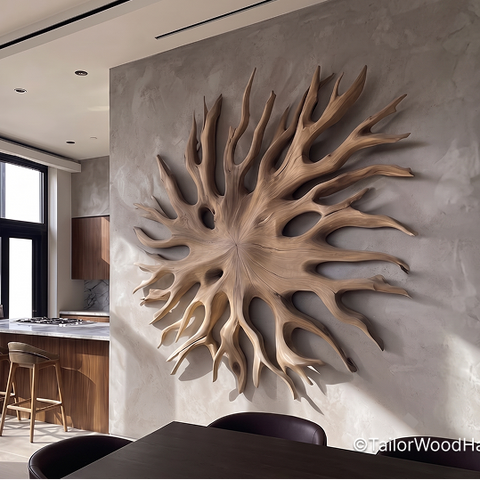
Wood expands and contracts slightly no matter how well it's sealed, and a rigid mounting method that doesn't account for that movement can actually cause or worsen warping over time. When hanging substantial geometric pieces like the Sunburst Driftwood Wall Panel with Layered Natural Wood Texture, using a French cleat or a floating mount that supports the piece without pinning every edge tightly in place gives the wood a small amount of room to move naturally with the seasons.
Avoid mounting methods that clamp or screw a large panel down at multiple rigid points around its full perimeter, since that kind of fixed constraint fights against the wood's natural movement instead of accommodating it.
Start with Well-Dried, Quality Wood
Some of the risk of warping is determined before a piece ever reaches your wall. Properly kiln-dried or well-seasoned wood has a lower and more stable starting moisture content than green or improperly dried lumber, which means it has less internal moisture to lose or gain once it's in your home. This is one of the reasons handcrafted geometric pieces like the Chevron Groove Wood Wall Panel for Modern Rustic Interiors tend to hold up better over time than a piece built from wood that wasn't given the time to season properly before being shaped and finished.
Investing in properly seasoned materials to minimize future moisture loss
Frequently Asked Questions About Wood Wall Art Warping
A few questions come up often once people start paying attention to humidity, sealing, and placement, so here's a quick rundown of the ones worth knowing.
Can warped wood wall art be fixed?
A slight warp caught early can sometimes be corrected. Placing the piece in a room with more balanced humidity and, for a mild warp, lightly dampening the concave side while weighting the piece flat for several days can sometimes coax it back into shape. This works best on solid, unfinished or lightly finished wood rather than a heavily sealed or veneered piece. For a warp that's more significant or has been there a long time, it's usually more realistic to focus on preventing further movement than fully reversing what's already happened.
What humidity level is best for wood wall art?
Somewhere between 30 and 50 percent relative humidity is generally considered safe for most indoor wood pieces. The bigger risk usually isn't sitting slightly outside that range, it's swinging widely between very dry and very humid conditions from one season to the next.
Does sealing the back of a piece really make a difference?
Yes. An unfinished back absorbs and releases moisture at a different rate than a sealed front, and that mismatch alone is enough to cause warping even when the room's humidity is otherwise stable. Sealing every surface, not just the visible front, is one of the simplest and most effective ways to prevent it.
Sealing all sides of the wood helps balance moisture absorption and significantly reduces the risk of warping over time
How long does new wood wall art need to acclimate before hanging?
Somewhere around 72 to 96 hours in the room it will actually hang in is a reasonable window for most pieces. This gives the wood time to adjust to the local humidity before it's mounted under any tension from hanging hardware.
Is a bathroom or kitchen a bad spot for wood wall art?
Both tend to see bigger, faster humidity swings than the rest of a home, from showers, cooking steam, and general moisture, which makes them higher-risk locations for warping. If you do want wood art in either room, a piece with a fully sealed surface on all sides and a mounting method that allows some movement will hold up better than one without.
Warping in wood wall art almost always comes down to uneven moisture exchange, and nearly every prevention strategy comes back to reducing that imbalance, whether through stable humidity, full-surface sealing, sensible placement, or a mounting method that lets the wood move slightly rather than fighting it. None of these habits require much effort once they're in place, and together they're what separates a piece that stays flat and beautiful for decades from one that starts bowing within its first year on the wall.
Looking for wood wall art built to last from properly dried, quality wood? Visit Tailor Wood Haven to explore our full range of handcrafted wood wall art, or browse the Carved Wood Wall Art, Driftwood Wall Art, and Wood Wall Art collections for pieces made to hold their shape for years to come.
|
TAILOR WOOD HAVEN
Address 1: 412 Palmetto Dr, Columbia, SC 29201
Address 2: 1201 Hillside Avenue, Victoria, British Columbia V8T 2B1, Canada
Address 3: Phu Thai Town, Hai Phong 03306, Vietnam
Call us: +1 (647)-608-1571
Email: hello@tailorwoodhaven.com
|
 Skip to content


 Farmhouse Floating Shelves – Perfect handcrafted furniture
 Farmhouse Narrow Console Table with Storage for Entryway or Living Room
 Custom Rustic Console – Natural Wood, Made to Order