Most homes have far more wood in them than people initially notice: flooring, doors, trim, furniture, cabinetry, and decor accents all bring their own tone into a room, often from different sources and different eras of buying decisions. Getting all of it to feel intentional rather than accidental doesn't mean matching every piece of wood exactly, it means understanding a few core principles about undertone, proportion, and where contrast actually works in your favor. This guide covers those fundamentals, walks through where wood tones typically show up in a home, and covers the mistakes that trip people up most often.
Wood Tone Chart: Warm, Cool, and Neutral Undertones
Before matching anything, it helps to know which broad undertone family a given wood falls into, since undertone matters far more for a cohesive look than matching exact species.
|
Undertone
|
Common Wood Species
|
Typical Finishes
|
Feel
|
|
Warm
|
Oak, cherry, pine, mahogany, teak
|
Honey, amber, red-brown, natural
|
Cozy, traditional, inviting
|
|
Cool
|
Walnut, ash, some maple
|
Gray-washed, ebonized, espresso
|
Contemporary, minimal, moody
|
|
Neutral
|
Birch, some maple, driftwood, bamboo
|
Whitewash, raw, bleached, light natural
|
Flexible, easy to mix with either warm or cool
|
Warm woods carry visible red, orange, or golden undertones. Cool woods lean gray or ashy. Neutral woods sit in between and are the easiest tone to introduce into a home that already has a mix of warm and cool wood elements, since they don't compete strongly with either direction.
Identifying the color families that make up your interior palette
Core Principles for Matching Wood Tones
A handful of guidelines apply almost everywhere in a home, whether you're pairing a coffee table with flooring or a piece of wall art with a media console.
Match Undertone Before Species
Trying to match wood species exactly across a room, hunting for furniture in the same type of wood as your floor, is rarely necessary and often impossible anyway, since natural wood varies piece to piece even within a single species. What matters more is undertone: keeping warm-toned pieces near other warm-toned pieces, and cool-toned pieces near other cool ones, rather than chasing an identical species or stain color.
Focusing on color temperature instead of hunting for identical materials
Follow a Rough 80/20 Ratio
A useful rule of thumb across a whole room, or even a whole home, is to keep roughly 80 percent of visible wood in one dominant tone, with the remaining 20 percent as an intentional accent in a contrasting tone. This ratio keeps a room from feeling flat and overly matched while still giving it a clear sense of direction, rather than splitting evenly between two competing tones that fight for attention.
Match Grain Scale, Not Just Color
Wood grain comes in different scales, from the tight, fine grain of maple or cherry to the bold, open grain of oak or walnut. Pairing a fine-grained piece with another fine-grained piece, or a bold-grained piece with another bold one, creates harmony even when the actual color tones differ somewhat. Mixing a very fine, smooth grain with a rough, heavily figured one can work, but it tends to read as more of a deliberate style choice than an accidental one.
For instance, pairing a sleek mid-century table with a highly textured, dimensional piece like the Chevron Leaf Wood Wall Panel for Rustic Interiors introduces intentional contrast that elevates the room's design while still feeling grounded in natural materials.
Pairing visual textures from fine lines to bold organic patterns
Where Wood Tones Show Up in a Home
Wood tone matching plays out a little differently depending on which surface or object you're dealing with, since each one carries a different amount of visual weight in a room.
Flooring as the Foundation
Flooring is usually the largest, most fixed wood element in a home, and it's also the hardest and most expensive to change, so it typically makes the most sense to treat it as the anchor tone for everything else rather than trying to match new furniture and decor to it after the fact. If your floors are warm oak, leaning warm with furniture and decor throughout the connected living spaces creates the most cohesive result, even if individual pieces vary somewhat in exact shade.
Using your largest architectural element as the room's anchor tone
Furniture as the Secondary Layer
Furniture is the next largest wood presence in most rooms, and it has more flexibility than flooring, since pieces are easier to swap or reupholster over time. This is where the 80/20 principle becomes most useful: let your largest furniture pieces, a dining table, a media console, a bed frame, follow the room's dominant tone, and reserve any contrasting tone for smaller, secondary furniture pieces like a side table or an accent chair frame.
>>> Read more: How to Match Wood Wall Art with Furniture: A Complete Wood Tone Guide
Trim, Doors, and Cabinetry
Stained wood trim, doors, and cabinetry are more fixed than furniture but still show up as a meaningful chunk of visual wood tone in a room, particularly in kitchens and older homes with a lot of original woodwork. If these elements are original to the house and not easily changed, it's often easier to treat them as the anchor, similar to flooring, and choose furniture and decor to complement that tone rather than fighting against it with an entirely different palette.
Working with existing architectural woodwork in older or renovated homes
Wall Art and Decor Accents
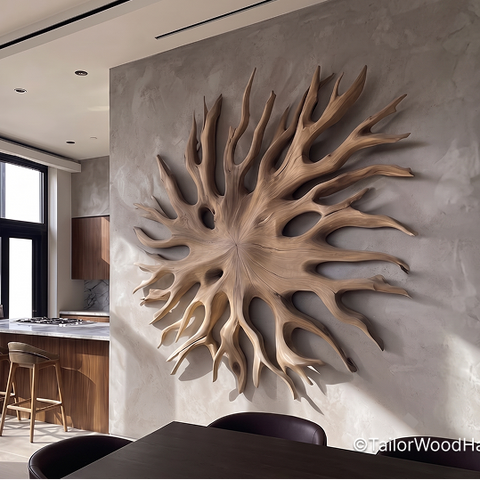
Wall art, picture frames, and small decor objects are the most flexible wood elements in a home, since they're the easiest and cheapest to swap out if a tone isn't working. This makes them a great place to introduce a secondary or accent tone within the 80/20 ratio, adding some visual interest and depth without committing to a full room overhaul. A cool-toned, organically shaped focal point, such as the Wall Wood Sculpture – Organic Wood Wall Sculpture Handcrafted for Artistic and Rustic Interior Design, can work beautifully in a room with warm oak floors and furniture, as long as it stays in that smaller accent role rather than trying to dominate the space.
Creating Flow Between Rooms
Wood tone matching doesn't have to stop at a single room's doorway. In an open floor plan, or simply moving from a hallway into adjoining rooms, a noticeable jump between one dominant wood tone and a completely different one can feel jarring, even if each individual room looks fine on its own. A gradual transition works better than an abrupt one: if your living room leans warm oak and you want a different tone in an adjacent dining room, introducing a bridging element, a rug, a piece of furniture, or a light fixture that shares some undertone with both spaces, softens the shift and keeps the whole floor feeling connected rather than like two separate design projects.
For homes with genuinely mismatched wood tones from different renovation eras, a shared metal finish, black iron, brass, or another consistent hardware and fixture choice throughout, is one of the most effective ways to visually tie everything together without refinishing every wood surface in the house.
Ensuring smooth visual transitions across open floor plans and hallways
Common Mistakes and How to Test Your Choices
A few habits are responsible for most wood tone mismatches, and a bit of testing before committing to a purchase heads off nearly all of them.
Common Mistakes to Avoid
-
Judging tone under artificial light only — warm indoor bulbs shift how wood reads, so always double-check a pairing in natural daylight before deciding
-
Trying to match every wood surface exactly — a room where the floor, furniture, and trim are all identical tones can feel flat and showroom-like rather than lived-in
-
Buying based on online photos alone — screens vary in color rendering, and a wood tone can look noticeably warmer or cooler online than it does in person
-
Ignoring grain scale while focused on color — two pieces in a similar color but very different grain patterns can still feel mismatched despite the tone technically lining up
Recognizing errors in showroom matching and digital color distortion
How to Test a Pairing Before You Commit
Bring a small swatch, a paint chip, a fabric sample, or a photo, of your home's dominant wood tone whenever you're shopping for a new piece, and hold it up against the item in natural light rather than trusting memory or a photo alone. If you're considering a larger purchase, request an actual wood or finish sample from the retailer if one is available, since it gives a far more accurate sense of undertone than any photo can.
Frequently Asked Questions About Matching Wood Tones in Home Decor
A few questions come up often once people start paying closer attention to the wood tones throughout their home.
Do all the wood tones in my house need to match?
No. A home with a single dominant tone and a few intentional accent pieces in a contrasting tone almost always looks better than one where every wood surface is forced to match exactly. The goal is cohesion, not uniformity.
What's the easiest wood tone to mix with almost anything?
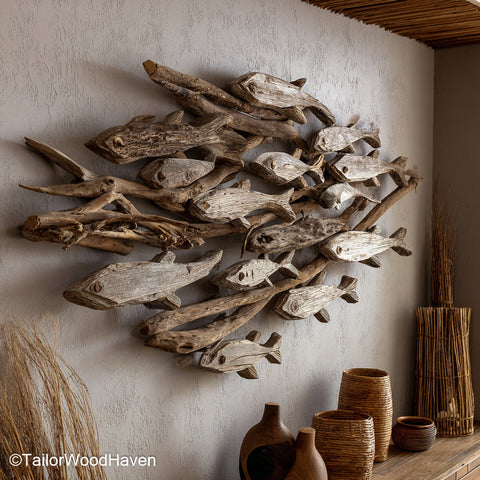
Neutral tones, like driftwood, whitewashed pine, or raw birch, are the most forgiving, since they don't lean strongly warm or cool and tend to sit comfortably next to either direction without clashing.
Can I mix warm and cool wood tones in the same room?
Yes, and plenty of well-designed rooms do exactly that. It works best when one tone clearly dominates, following something close to the 80/20 ratio, with the other tone appearing only in smaller accent pieces rather than splitting the room evenly.
Should flooring or furniture set the dominant tone?
Flooring is usually the better anchor, since it's the largest and most fixed wood element in most homes. Furniture and decor are easier and cheaper to adjust over time, so it generally makes more sense to build around the floor's existing tone rather than the other way around.
How do I fix a home with wood tones that clash badly?
A shared metal finish across hardware and fixtures is one of the fastest fixes without refinishing anything, since it gives mismatched wood tones a common visual thread. Beyond that, introducing more neutral-toned pieces gradually, and being selective about which tone gets the larger 80 percent share going forward, tends to correct the balance over time without a full renovation.
Matching wood tones throughout a home comes down to understanding undertone, keeping one tone clearly dominant, and paying attention to grain scale alongside color, rather than trying to force every wood surface into an identical match. Flooring and trim tend to set the tone for a space since they're the hardest to change, while furniture and wall art offer the flexibility to introduce a bit of intentional contrast within that framework. Get the proportions right, and a home can comfortably hold several different wood tones at once without ever feeling mismatched.
Looking for a wood wall art piece to complete the look? Visit Tailor Wood Haven to explore our full range of handcrafted wood wall art, or browse the Carved Wood Wall Art, Driftwood Wall Art, and Wood Wall Art collections for pieces spanning a wide range of tones to fit almost any home.
|
TAILOR WOOD HAVEN
Address 1: 412 Palmetto Dr, Columbia, SC 29201
Address 2: 1201 Hillside Avenue, Victoria, British Columbia V8T 2B1, Canada
Address 3: Phu Thai Town, Hai Phong 03306, Vietnam
Call us: +1 (647)-608-1571
Email: hello@tailorwoodhaven.com
|
 Skip to content


 Farmhouse Floating Shelves – Perfect handcrafted furniture
 Farmhouse Narrow Console Table with Storage for Entryway or Living Room
 Custom Rustic Console – Natural Wood, Made to Order