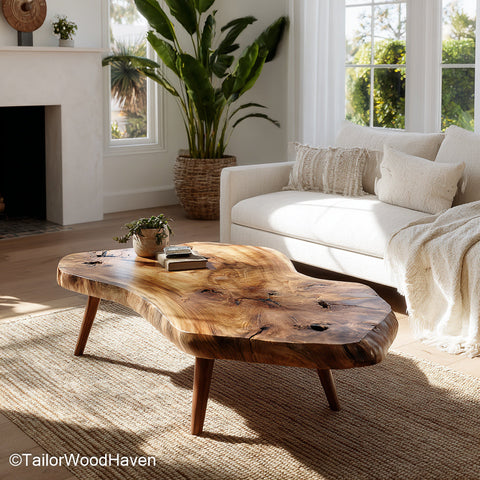
Removing bark from a live edge slab takes patience and the right tools. The goal is to remove loose bark and clean the edge without damaging the wood's natural curves, grain, or character.
Whether you're preparing a slab for a live edge coffee table, dining table, or another woodworking project, the process is straightforward. Here's how to remove bark safely while preserving the natural live edge.
Before starting, gather a few basic woodworking tools:
- Chisel and mallet: Help lift stubborn bark from the edge.
- Drawknife or debarking tool: Useful for removing larger sections of bark.
- Soft or stiff-bristle brush: Removes loose debris and remaining bark particles.
- Sandpaper: Smooths rough fibers along the edge.
- Safety glasses and gloves: Help protect your eyes and hands during the process.
You may not need every tool. If the bark is already loose, a simple hand tool and brush may be enough.
How to Remove Bark from a Live Edge Slab
Follow these steps to remove bark while keeping the slab's natural shape intact.
1. Secure the Wood Slab
Place the slab on a stable workbench or work surface and secure it with clamps. Make sure it cannot shift while you're working along the edge.
Position the slab so you can reach the entire live edge comfortably. A stable setup gives you better control and reduces the risk of slipping with sharp tools.

2. Remove Loose Bark by Hand
Start by checking how firmly the bark is attached. Use your fingers or a suitable blunt tool to lift sections that are already loose.
Work along the edge and remove what comes away easily. Avoid pulling aggressively, as bark can catch on the wood and tear away small sections of the natural edge.
If the bark is firmly attached, leave it for the next step rather than forcing it off.

3. Use a Chisel to Remove Stubborn Bark
For bark that remains attached, use a sharp chisel and mallet. Position the chisel carefully between the bark and the wood, then apply light, controlled pressure to separate the layers.
Work in small sections instead of trying to remove a large piece at once. Follow the natural contour of the slab and avoid cutting deeply into the wood.
A drawknife or debarking tool may also help with thicker bark, but it requires careful handling. Always keep your hands clear of the cutting path and work with controlled movements.
Some bark may leave behind a thin layer of cambium or fibrous material. Remove only what is necessary to clean the edge without changing its natural profile.

4. Clean the Live Edge
Once the main bark has been removed, inspect the edge for loose fibers, dirt, and small remaining pieces.
Use a suitable brush to clean the surface. A nylon brush is a good starting point when you want to minimize scratching. A brass or steel wire brush may be appropriate for certain slabs, but test it in an inconspicuous area first because it can mark softer wood.
Pay attention to crevices and uneven sections where bark fragments may remain. Avoid aggressive scraping that could flatten the contours or damage the grain.

5. Sand the Edge Smooth
After cleaning, lightly sand rough fibers and sharp spots along the edge.
Start with suitable medium-grit sandpaper and move to a finer grit if needed. Follow the natural outline of the slab rather than sanding the edge into a uniform shape.
The aim is to remove splinters and create a comfortable surface, not to make the live edge look machine-cut. Keep the natural curves, knots, and distinctive features that give the slab its character.
If the slab's surface is uneven, follow our guide on how to flatten a live edge slab to prepare it for the next stage of your woodworking project.

How to Remove Bark Without Damaging the Live Edge
The biggest challenge is removing the bark without taking too much wood with it. These tips can help:
- Work slowly: Small sections are easier to control than large pieces.
- Use sharp tools carefully: Dull tools may require more force, increasing the chance of slipping.
- Follow the natural contour: Do not straighten irregular edges just to make them look uniform.
- Avoid excessive sanding: Too much material removal can change the slab's original shape.
- Check for hidden defects: Loose fibers, cracks, and decayed areas may become visible after the bark comes off.
If a section of bark is deeply embedded or removing it would damage the live edge, reassess your approach rather than forcing it. Some irregularities are part of the wood's natural character.
Always wear appropriate eye protection and follow safe tool-handling practices.
Should You Remove the Bark from a Live Edge Slab?
For most live edge furniture intended for regular indoor use, removing the bark is the more practical choice.
Bark can loosen, crumble, and fall off as the wood dries or the furniture is used. It may also trap dust and make the edge harder to clean. Removing it generally creates a more stable, manageable surface for finishing and everyday use.
However, removing bark does not mean removing the live edge itself. The natural outline of the tree can remain intact after the bark is gone.
If you want a natural appearance, focus on preserving the wood's curves and grain rather than keeping the bark attached. The finished edge can still look organic and distinctive without the bark.

See more: How to Make a Live Edge Coffee Table Step by Step
What to Do After Removing Bark from a Live Edge Slab
After removing the bark, inspect the entire edge for loose fibers, cracks, soft spots, or remaining debris. Address any areas that could affect the slab's stability or finished appearance.
Make sure the wood has reached an appropriate moisture content for its intended use before applying a finish or assembling the furniture. Learn more about drying live edge slabs to understand how proper drying helps reduce the risk of excessive movement, cracking, and warping.
Once the slab is clean, dry, and properly prepared, follow our guide on how to finish a live edge slab to protect the wood and bring out its natural grain.
For a successful live edge project, take your time during bark removal. A clean edge that retains the slab's original shape will give the finished piece a more natural, well-crafted appearance.
 Skip to content


 Farmhouse Floating Shelves – Perfect handcrafted furniture
 Farmhouse Narrow Console Table with Storage for Entryway or Living Room
 Custom Rustic Console – Natural Wood, Made to Order