Your cart (0)
Your cart is empty
Tax included and shipping calculated at checkout
Recommended products


Drawer menu
Tax included and shipping calculated at checkout


A diy wood slab coffee table is the ultimate celebration of nature's raw geometry. By preserving the organic "live-edge" of a single timber slice, you create a functional sculpture that tells a unique story.
This project transforms a rugged piece of earth into a sophisticated, professional-grade centerpiece for your home.
Finding the perfect piece of timber is 70% of the work in a diy wood slab coffee table project. Since you are working with a solid cross-section of a tree, you must prioritize stability and moisture control over mere aesthetics.
Don't limit yourself to big-box hardware stores. For a truly unique diy wood slab coffee table, explore these professional sources:

A solid wood slab with rich grain and a natural edge, highlighting the organic texture required for a premium diy wood slab coffee table.
Before purchasing your timber for a diy wood slab coffee table, use this checklist to ensure the wood is workable:
Look for a slab that lies relatively flat. While a slight "cup" or "bow" can be fixed, a severe twist will require removing too much thickness.
Remember: natural cracks (checks) can be beautiful, provided they are stabilized later, but avoid any wood with soft, punky areas that indicate rot.

A handmade live-edge surface showcasing a perfectly leveled plane, essential for ensuring stability in a high-quality wood slab coffee table design.
Flattening a raw slab is often the most intimidating part of a diy wood slab coffee table. If the surface isn't perfectly level, your legs will wobble, and your drinks will slide.
While you can use a router plane or hand planes, there is a professional shortcut that saves hours of grueling labor.
The "secret" used by many high-end furniture makers is outsourcing the initial leveling. Many local lumber yards or cabinet shops offer a milling service for a small fee.
Once the faces are flat, you need to square the ends. Since your diy wood slab coffee table has organic, curved sides, you cannot use a standard fence.
For a deep dive into the technical assembly of a solid surface, this guide on building a slab top table offers excellent insights into professional milling standards.
Proper milling ensures your diy wood slab coffee table remains a stable, flat heirloom for generations.
A raw timber slice is a living thing that continues to move and breathe. To ensure your diy wood slab coffee table doesn't split further over time, you must stabilize its natural "character marks": the cracks, knots, and voids that make the wood unique.

A premium walnut slab with stabilized natural voids, showcasing the perfect blend of raw texture and luxurious, refined finish.
Epoxy is the modern woodworker's best friend for a diy wood slab coffee table. It turns a structural weakness into a visual highlight.
For larger "checks" or cracks that threaten the integrity of your diy wood slab coffee table, a butterfly joint is a mechanical necessity.
Before moving to the finishing stage, run your hand over every stabilized area. A well-prepared diy wood slab coffee table should feel like one continuous, solid surface.
By reinforcing these defects, you are not just fixing a piece of wood; you are guaranteeing that your diy wood slab coffee table survives the seasonal humidity changes in your home without losing its shape.
Sanding is the bridge between a rough piece of lumber and a gallery-quality diy wood slab coffee table.
This stage requires patience, but it is the most rewarding part of the build, as each grit level brings you closer to revealing the "inner magic" of the timber's grain.
To achieve a professional finish on your diy wood slab coffee table, you must follow a strict progression. Skipping a grit will leave visible swirl marks that only appear once the oil is applied.
The "ends" of your diy wood slab coffee table (where the rings of the tree are visible) are like straws - they soak up more finish and sand differently than the flat surface.
The moment you apply the first coat of finish to your diy wood slab coffee table, the colors will "pop" with incredible depth.
Pro Application Tip:
When finishing your diy wood slab coffee table, always apply the product in the direction of the grain. Use a lint-free cloth or a high-quality foam brush to avoid leaving bubbles or streaks.
A methodical sanding and finishing process ensures the raw character of your slab is preserved while providing a surface that is soft to the touch and visually stunning.

A striking raw-edge hardwood slab that commands attention, serving as the ultimate organic centerpiece for a diy wood slab coffee table.
Selecting the right legs for your diy wood slab coffee table is about more than just aesthetics; it is about providing a stable foundation for a heavy, organic top.
The base should complement the slab's natural curves without overshadowing its unique character.
Depending on your interior design, you can choose from several popular options:
By using high-quality fasteners and ensuring a balanced stance, your masterpiece will remain stable and secure for a lifetime of use.
Navigating the unique challenges of a diy wood slab coffee table often leads to technical questions.
To help you achieve a professional result, here are the most common inquiries from the woodworking community:
The best way to ensure stability is to use kiln-dried timber and apply a finish to both the top and the bottom of the slab. This seals the wood fibers equally, preventing uneven moisture absorption.
Sticky resin usually results from an incorrect mixing ratio. You can often fix this by scraping away the soft material and pouring a fresh, properly measured layer of epoxy over the area.
If you are using a porous wood like Pine or Maple for your diy wood slab coffee table, a conditioner helps prevent "blotchiness" and ensures a uniform color.
Use metal shims or adjustable furniture glides on the bottom of the legs. This allows you to level the table perfectly, even if the underside of your slab has slight natural variations.

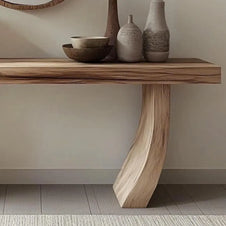
A thick wood slab with a smooth, natural-edge surface and minimalist legs, representing the peak of organic modern design and craftsmanship.
Crafting a diy wood slab coffee table is a journey of uncovering nature's hidden geometry. By mastering the art of flattening, stabilizing, and finishing, you've turned a raw slice of timber into a timeless heirloom.
Enjoy the warmth and organic beauty that only a handcrafted, live-edge masterpiece can bring to your home.


