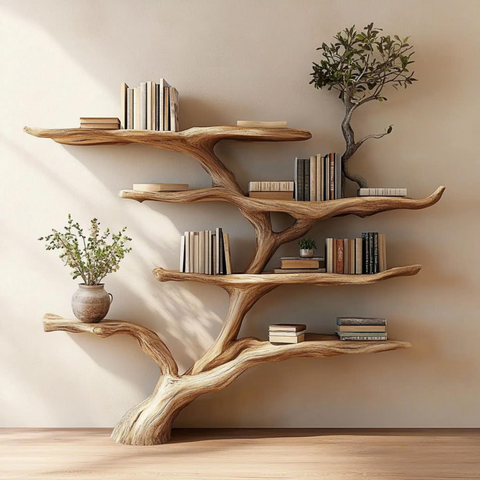
A tree bookshelf can hold a surprising number of books, but there is no single capacity that applies to every design. The number depends on the usable shelf space, the size and weight of your books, the number and shape of its branches, and how the bookshelf is constructed. This guide explains how to estimate the capacity of a tree bookshelf and arrange your collection without overloading the shelves.
1. How Many Books Can a Tree Bookshelf Hold?
The number of books a tree bookshelf can hold depends mainly on its shelf dimensions, number of storage sections, and the size of the books being stored. A compact tree bookshelf with short branches may be better suited to a small collection, while a larger tree bookcase with wider and deeper shelves can accommodate considerably more.
Unlike a conventional rectangular bookcase, a tree branch bookshelf often has shelves or branches with different lengths and shapes. This means its total capacity is better estimated shelf by shelf rather than by using one standard number.
For example, a shelf that provides 24 inches of usable space could theoretically hold around 12 books if the average book is 2 inches thick. In practice, you may want to leave some room between books, so the actual number could be lower.
The number of books a tree bookshelf can hold depends on many factors
2. How Do You Estimate the Number of Books a Tree Bookshelf Can Hold?
To estimate bookshelf capacity, measure the usable space on each shelf and compare it with the average thickness of your books. This gives you a rough estimate that can then be adjusted based on spacing, book size, and the shelf's weight limitations.
2.1 Measure the Usable Shelf Space
Start by measuring the actual length of each branch or shelf where books can sit. Do not simply use the overall width of the tree bookshelf. Because curved, tapered, or branching designs may have areas that cannot be used for book storage.
If the shelves have different lengths, measure each one separately. Add those measurements together if you want to estimate the total available horizontal space.
2.2 Consider the Average Width of Your Books
Next, consider the average thickness of the books you plan to store. A collection of paperbacks may take up significantly less space than a collection of large hardcover books.
You can get a useful estimate by measuring a representative group of books. For example, if 10 typical books occupy 12 inches of shelf space, their average thickness is approximately 1.2 inches per book.
Consider the average thickness of your book to plan the storage
2.3 Calculate Capacity Shelf by Shelf
Once you know the usable shelf length and average book thickness, you can estimate capacity with a simple calculation:
For example, a 24-inch shelf with books averaging 1.5 inches thick could accommodate roughly 16 books when fully packed.
However, this is only an estimate. You may choose to leave some space between books, use horizontal stacks, or reserve sections for décor. The practical capacity will therefore usually be lower than the maximum calculated number.
2.4 Leave Room Between Books
A bookshelf does not need to be packed from one end to the other. Leaving a little space between groups makes books easier to remove and gives the overall arrangement a more relaxed appearance.
This is particularly useful with a tree bookshelf because its branch-like structure already creates natural visual separation. You can use shorter branches for small groups of books or decorative objects instead of trying to maximize every available inch.
See more: How to Arrange Books on Shelves: Simple Ways to Create a Beautiful Bookshelf
3. Does the Shape of a Tree Bookshelf Affect How Many Books It Can Hold?
Yes, the shape of a tree bookshelf can significantly affect its capacity. Unlike a conventional bookcase with uniform shelves, tree-inspired designs often use branches or compartments of different lengths, depths, and proportions. As a result, some areas may be better for books while others are better suited to smaller objects.
3.1 Wider Branches Hold More Books
Wider branches provide more usable horizontal space, allowing you to store a larger group of books. They can also accommodate horizontal stacks or larger decorative objects.
If storage capacity is a priority, look for a tree bookshelf with several substantial branches rather than a design made primarily from short display shelves.
Wider branches provide more usable horizontal space
3.2 Shorter Branches Are Better for Small Collections
Short branches may not hold many books, but that does not make them less useful. They can work well for smaller collections, favorite titles, plants, framed artwork, or other decorative objects.
A tree bookshelf is often intended to combine storage and display. Using some of the smaller branches for décor can make the entire arrangement more visually balanced.
3.3 Deeper Shelves Can Accommodate Larger Books
Shelf depth determines what types of books can sit comfortably on the bookshelf. Deeper shelves can accommodate larger hardcovers, art books, and other oversized publications that may not fit comfortably on shallow branches.
However, greater depth does not automatically mean greater book capacity. If the shelves are deep but relatively short, you may still have limited horizontal space for storing books.
Deeper shelves can accommodate larger books
3.4 Asymmetrical Branches Create Different Storage Zones
One of the distinctive features of a tree bookshelf is that its branches can create storage areas with different proportions. This allows you to organize books according to their size while using other sections for decorative objects.
For example, larger branches can hold rows of books, while smaller branches can display a plant, sculpture, or a few favorite titles. This makes the bookshelf function as both storage furniture and a visual feature.
4. How Should You Arrange Books on a Tree Bookshelf?
Books should be arranged on a tree bookshelf according to both their weight and the proportions of each branch. Heavier books are generally better placed on lower, well-supported shelves, while smaller books and decorative objects can occupy shorter or higher branches.
4.1 Put Heavier Books on Lower Shelves
Placing heavier books lower on the bookshelf can create a more stable arrangement and reduce the amount of weight placed on higher sections. Large hardcover books, photography books, and art books are good candidates for lower shelves when the design allows it.
Always follow the bookshelf's stated weight limits if they are provided. The structure and mounting method matter just as much as the appearance of the shelves.
4.2 Group Books by Size
Grouping books of similar sizes can make the unusual structure of a tree bookshelf feel more organized. Taller books can occupy larger branches, while shorter books can be grouped together on smaller sections.
You can also use horizontal stacks to accommodate books that do not fit naturally with the surrounding vertical rows.
Group books by size
4.3 Mix Vertical and Horizontal Arrangements
Combining upright books with horizontal stacks adds variety and makes better use of differently shaped branches. A small horizontal stack can also create a surface for a plant or decorative object.
Avoid making every branch follow the same arrangement. Some variation works particularly well with the organic structure of a tree-inspired bookshelf.
4.4 Use Smaller Branches for Décor
Not every branch needs to hold books. Smaller sections can be used for plants, ceramics, framed photographs, sculptures, or other objects.
This can actually make the bookshelf more functional because it allows you to use spaces that may not be large enough for a row of books.
4.5 Leave Some Empty Space
Empty space is useful both visually and practically. Leaving some branches partially empty prevents the bookshelf from looking overcrowded and gives you room to add new books later.
It also allows the natural shape of the tree bookshelf to remain visible instead of being completely hidden behind books and décor.
Leave some empty space on the shelf
5. Is a Tree Bookshelf Good for a Large Book Collection?
A tree bookshelf can work for a large collection if the design provides enough shelf space and weight capacity, but it is generally more suitable when you want to combine book storage with display. A traditional tall or wall-to-wall bookcase may be more efficient if your primary goal is to maximize the number of books stored.
A tree bookshelf can be a good choice for a larger collection when:
-
The bookshelf has multiple wide branches.
-
The shelves are deep enough for your books.
-
The structure is designed to support the expected load.
-
You are comfortable combining book storage with decorative space.
-
You want your collection to function as part of the room's design.
If you have hundreds of books and need every available inch for storage, a conventional bookcase may provide more predictable capacity. If you want a smaller collection to become part of the room's decor, a tree bookshelf can offer a more distinctive solution.
For a handcrafted natural wood design, Tailor Wood Haven can customize the size, shape, wood, and finish of a bookshelf based on the space and storage requirements you have in mind.
6. Frequently Asked Questions About Tree Bookshelf Capacity
6.1 Are Tree Bookshelves Strong Enough for Heavy Books?
A tree bookshelf can be strong enough for heavy books when its materials and construction are designed to support the intended load. However, strength varies between designs, so you should not assume that every tree bookshelf has the same weight capacity.
For particularly heavy books, check the manufacturer's specifications and consider how the weight will be distributed across the shelves. Avoid concentrating a large amount of weight on a small or lightly supported branch.
Are tree bookshelves strong enough for heavy books?
6.2 How Much Weight Can a Tree Bookshelf Hold?
There is no universal weight limit for a tree bookshelf. Its capacity depends on factors such as the material, shelf thickness, construction, support structure, dimensions, and whether the piece is freestanding or wall-mounted.
If a manufacturer provides a weight rating, use that specification rather than relying on a general estimate. For a custom piece, the expected load should be considered during the design process.
6.3 Are Tree Bookshelves Good for Small Spaces?
Yes, a tree bookshelf can work well in a small space, particularly when its vertical structure provides storage without requiring a large footprint. Its open design can also feel lighter than a large enclosed bookcase.
The key is choosing proportions that match the room. A tall, narrow tree bookshelf may work better than a wide design in a compact room, while open sections can help preserve visual space.
A tree bookshelf can work well in a small space
6.4 Can You Put Décor on a Tree Bookshelf?
Yes. In fact, combining books with décor can make a tree bookshelf feel more balanced and emphasize its organic shape. Plants, ceramics, artwork, small sculptures, and natural objects can occupy branches that are too short or shallow for a large group of books.
Try to keep a mix of books and decorative objects rather than filling every branch with one type of item. Leaving some sections empty can also make the display feel less cluttered.
6.5 Can a Tree Bookshelf Be Custom-Made?
Yes, a tree bookshelf can be custom-made to suit a particular space, collection, or interior style. Customization can include the overall dimensions, branch configuration, wood type, and finish.
This can be useful when you have specific capacity requirements or want the bookshelf to fit an unusual wall or corner. Tailor Wood Haven offers handcrafted natural wood furniture with customizable size, shape, wood, and finish, allowing the design to be adapted to your space and preferences.
There is no single answer to how many books a tree bookshelf can hold because capacity depends on the design, usable shelf space, book thickness, shelf depth, and structural strength. The most reliable approach is to measure each shelf or branch, estimate the average thickness of your books, and calculate capacity section by section.
A tree bookshelf is also more than a storage unit. Its different branch sizes can create natural zones for books, plants, artwork, and other objects, while some empty space allows the distinctive shape to remain visible. If you need a bookshelf designed around a particular collection or room, Tailor Wood Haven can customize the size, shape, wood, and finish to create a handcrafted piece that balances storage with visual character.
 Skip to content


 Farmhouse Floating Shelves – Perfect handcrafted furniture
 Farmhouse Narrow Console Table with Storage for Entryway or Living Room
 Custom Rustic Console – Natural Wood, Made to Order